Wall Sit
Exercise Overview
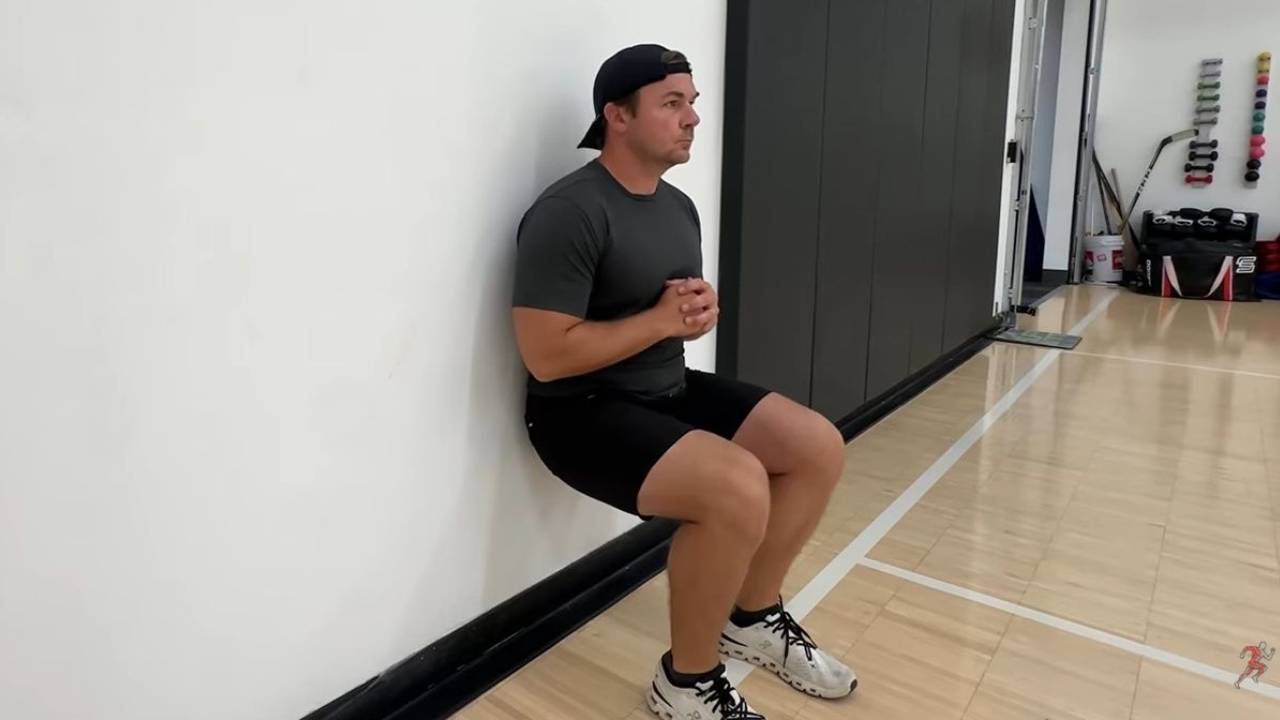
The wall sit is a bilateral isometric lower-extremity exercise that places sustained loading through the quadriceps while maintaining a fixed hip and knee position.
Clinical Purpose
Used to develop quadriceps strength, muscular endurance, and knee load tolerance in a stable closed-chain position.
Primary Muscles
Quadriceps
Secondary contribution from the gluteal musculature and other lower-extremity stabilizers.
How to Perform
Stand with your back against a wall and position the feet slightly forward. Slide down the wall until you reach the desired hip and knee position. Maintain full-foot contact and hold the position for the prescribed duration before returning to standing.
Coaching Cues
- Keep your back supported against the wall.
- Maintain full-foot contact.
- Keep the knees tracking over the feet.
- Hold a consistent depth throughout the set.
- Maintain even pressure through both legs.
- Breathe normally while maintaining tension.
Common Errors
- Gradually rising out of the position as fatigue develops.
- Allowing the knees to collapse inward.
- Shifting weight predominantly to one side.
- Losing full-foot contact.
- Using a depth that cannot be maintained.
- Holding the breath.
Common Clinical Uses
Knee rehabilitation, quadriceps strengthening, muscular-endurance development, isometric loading, and progression toward more demanding squat and lower-extremity strengthening exercises.
Programming
3–5 sets of 20–60 second holds.
Hold duration, knee angle, and total volume can be adjusted based on strength, symptoms, and rehabilitation goals.
Regression
Decrease squat depth, shorten the hold duration, or perform shorter repeated holds with additional recovery.
Progression
Increase hold duration, increase squat depth as appropriate, add external resistance, progress to a single-leg wall sit, or transition toward dynamic squat variations.
Equipment Needed
Bodyweight and a wall
Rehab Phase
Mid
PRO+ Clinical Pearl
Knee angle is an easy way to manipulate exercise demand. A deeper wall sit is not automatically better. Select a position that produces an appropriate quadriceps challenge while allowing the athlete to maintain consistent bilateral loading and position throughout the hold.
