
Tibialis Raises
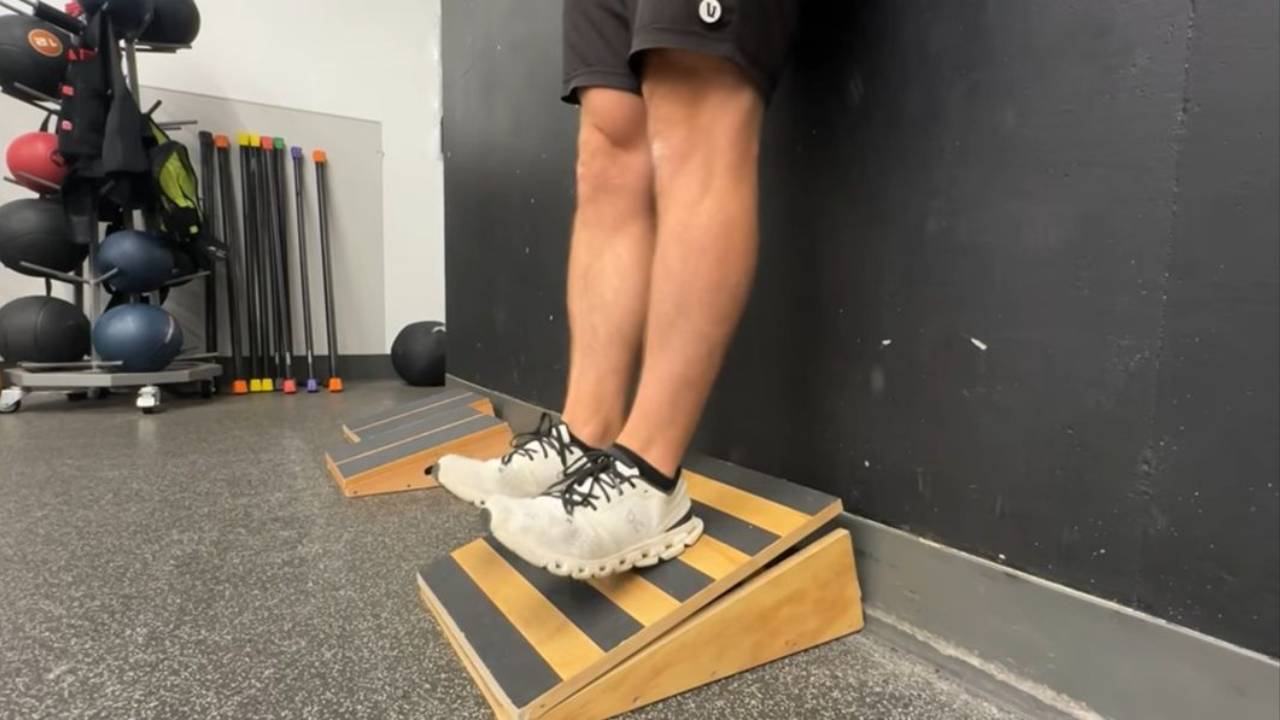
Exercise Overview
The Tibialis Raise is an ankle dorsiflexion strengthening exercise that primarily targets the tibialis anterior and other ankle dorsiflexors.
In this variation, the heels are positioned higher than the toes on an incline board, allowing the forefoot to begin below heel level. This increases the available range of motion compared with performing the exercise from a flat surface.
The athlete lowers the toes toward the floor under control and then actively pulls the forefoot upward into dorsiflexion while keeping the heels planted.
Clinical Purpose
The Tibialis Raise is used to improve ankle dorsiflexor strength, muscular endurance, and control through the available ankle range of motion.
Strengthening the tibialis anterior can be useful as part of lower-extremity rehabilitation, running preparation, ankle rehabilitation, and general lower-leg capacity development.
The incline-board variation allows the athlete to work through a larger excursion by beginning in greater plantarflexion before actively dorsiflexing the ankle.
Primary Muscles
Tibialis anterior and ankle dorsiflexors
How to Perform
- Stand on an incline board with your heels positioned higher than your toes.
- Position the feet approximately hip-width apart.
- Keep the heels firmly planted on the board throughout the exercise.
- Allow the toes and forefoot to lower toward the floor into a comfortable plantarflexed position.
- Keeping the heels down, pull the toes and forefoot upward toward the shins.
- Move as far into dorsiflexion as you can without compensating through the knees, hips, or trunk.
- Pause briefly at the top.
- Slowly lower the toes back below the level of the heels.
- Maintain control through the entire range of motion.
- Repeat for the prescribed number of repetitions.
Key Coaching Cues
- Keep your heels planted.
- Pull your toes toward your shins.
- Move through the ankle, not the knees.
- Lift the entire forefoot rather than just extending the toes.
- Pause at the top.
- Lower slowly.
- Use the full available range of motion.
- Keep the movement controlled from start to finish.
Common Errors
Lifting the heels
The heels should remain firmly supported throughout the exercise. Lifting the heels changes the movement and reduces the emphasis on ankle dorsiflexion.
Rocking the body backward
Avoid using momentum or shifting the entire body to create the movement. The motion should occur primarily at the ankle.
Excessive knee movement
Repeatedly bending and straightening the knees can compensate for limited ankle motion. Keep the legs relatively stable while the ankle performs the movement.
Moving too quickly
Dropping rapidly into plantarflexion removes much of the eccentric demand. Control both the lifting and lowering portions of the repetition.
Only lifting the toes
Avoid simply extending the toes. Think about lifting the entire forefoot toward the shin.
Using a range that causes pain
The incline board increases the available excursion. Use a comfortable range and modify the board angle if needed.
Common Clinical Uses
Lower-leg strengthening, ankle rehabilitation, running preparation, dorsiflexor weakness, ankle dorsiflexor endurance, return-to-running preparation, and general lower-extremity strength programming.
General Programming
A general starting point is:
2–4 sets of 10–20 repetitions
For muscular endurance, higher-repetition sets may also be appropriate:
2–3 sets of 20–30 repetitions
Use a controlled tempo and emphasize full available range of motion.
A useful starting tempo is approximately:
1–2 seconds up, brief pause, 2–3 seconds down
Progress volume or resistance once the athlete can maintain good control through the entire set.
Regression
- Perform the exercise on a flat surface.
- Reduce the incline-board angle.
- Use a smaller range of motion.
- Perform fewer repetitions.
- Use external support for balance.
- Perform bilateral repetitions before progressing to unilateral loading.
Progression
- Increase the incline-board angle to increase available range of motion.
- Increase repetition volume.
- Increase the eccentric lowering time.
- Add an isometric hold at peak dorsiflexion.
- Perform the exercise unilaterally.
- Add external resistance.
- Progress to more demanding ankle and lower-leg strengthening.
- Integrate into running, hopping, and return-to-sport programming when appropriate.
Equipment Needed
Incline board or slant board
Rehab Phase
Early to Late
PRO+ Clinical Pearl
The incline board changes more than the difficulty. It changes the available excursion.
With the toes positioned below the heels, the athlete begins the repetition in greater plantarflexion and must actively dorsiflex through a larger range of motion.
That can make the exercise useful when the goal is not simply producing more repetitions, but developing dorsiflexor strength and control throughout a greater ankle excursion.
Do not automatically chase the steepest board angle. Choose an incline that allows the athlete to maintain heel contact, control the eccentric lowering phase, and actively lift the forefoot without compensating through the knee or trunk.
