
Slider Reverse Lunge
Exercise Overview
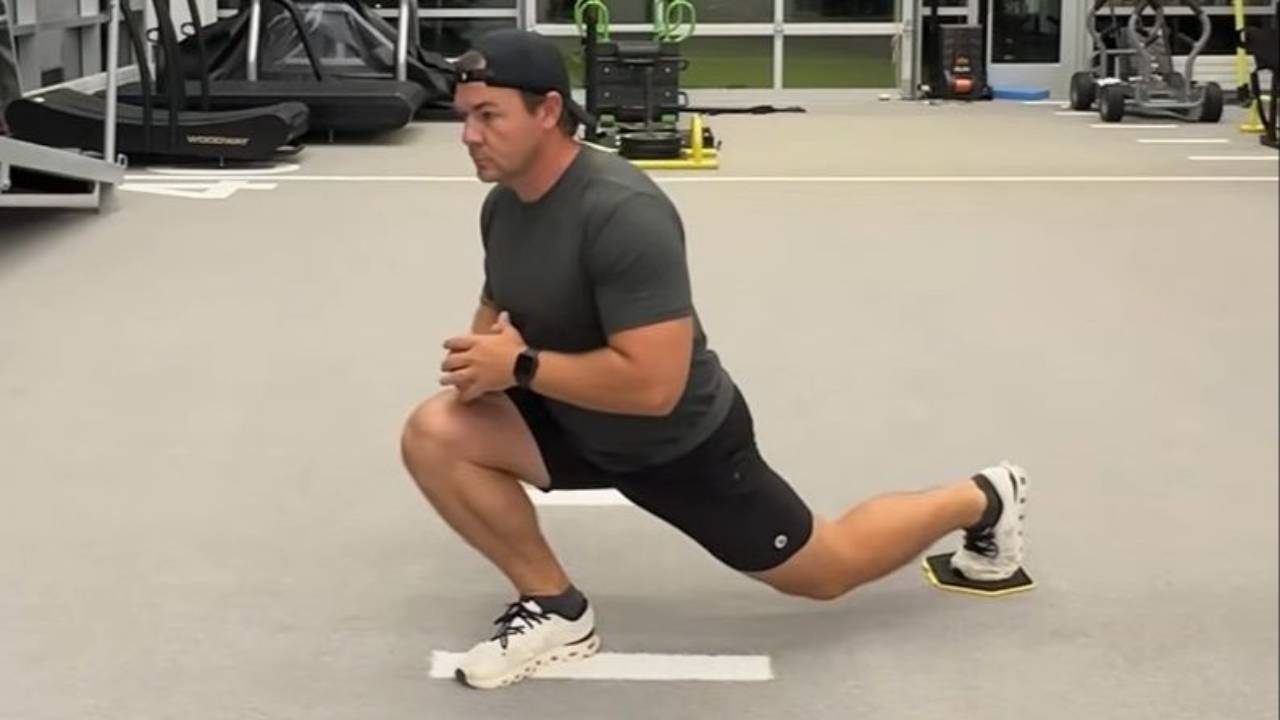
The slider reverse lunge is a unilateral lower-extremity strengthening exercise in which the stance leg accepts most of the load while the opposite leg slides posteriorly.
Clinical Purpose
Used to develop unilateral quadriceps and glute strength while improving hip and knee control through a supported reverse-lunge pattern.
Primary Muscles
Gluteus maximus, quadriceps
Secondary contribution from the hamstrings and adductors for lower-extremity control.
How to Perform
Stand with one foot firmly planted and the opposite foot positioned on a slider. Slide the non-stance leg backward while allowing the stance hip and knee to flex. Lower under control while keeping the majority of the load through the front leg. Drive through the stance leg as the sliding leg returns to the starting position.
Coaching Cues
- Keep most of the load through the front leg.
- Slide the rear foot rather than pushing forcefully through it.
- Maintain full-foot contact on the stance side.
- Allow the hip and knee to flex together.
- Keep the pelvis and trunk controlled.
- Drive through the stance leg to return to standing.
Common Errors
- Pushing excessively through the sliding leg.
- Allowing the stance knee to collapse inward.
- Losing front-foot contact.
- Taking an excessively long slider excursion.
- Excessive trunk rotation.
- Pulling back to the starting position primarily with the rear leg.
Common Clinical Uses
Hip rehabilitation, knee rehabilitation, unilateral lower-extremity strengthening, progressive lunge retraining, and return-to-activity preparation.
Programming
3–4 sets of 6–12 repetitions per side.
Slider distance, depth, tempo, repetition range, and external resistance can be modified according to the athlete’s strength and rehabilitation goals.
Regression
Decrease slider distance or depth, use external support for balance, or perform a static split squat.
Progression
Increase range of motion, add external resistance, slow the eccentric phase, add a pause at the bottom, or progress toward unsupported reverse lunges and more dynamic unilateral tasks.
Equipment Needed
Slider
Rehab Phase
Mid
PRO+ Clinical Pearl
The slider is useful because it reduces the need to repeatedly step into position while allowing the stance leg to remain continuously loaded. Keep the emphasis on loading and driving through the stance leg rather than using the rear leg to pull the body back to standing.
