Side Plank
Exercise Overview
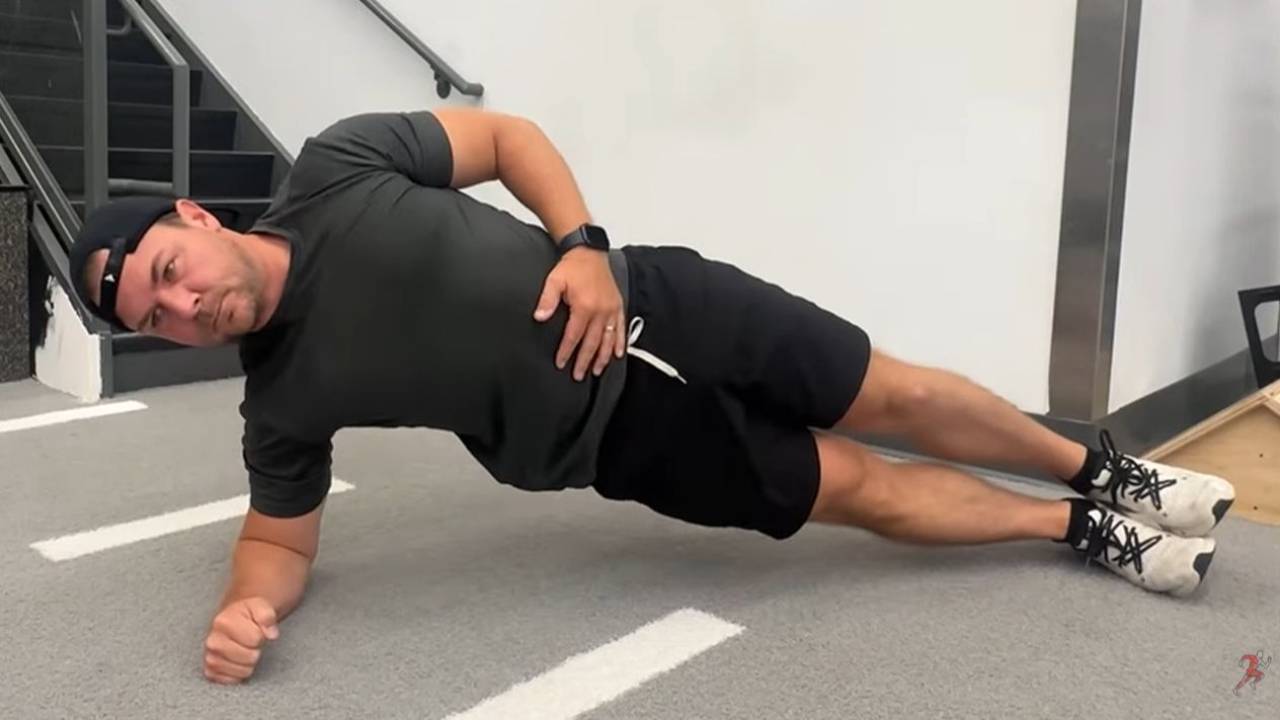
The side plank is an isometric trunk and hip-strengthening exercise that challenges the athlete to maintain alignment against gravity while resisting lateral trunk flexion and pelvic drop.
Clinical Purpose
Used to develop lateral trunk strength, hip stability, and frontal-plane control while improving the ability to maintain coordinated alignment through the trunk, pelvis, and lower extremities.
Primary Muscles
Obliques, quadratus lumborum, gluteus medius, gluteus minimus
Secondary contribution from the shoulder girdle and other trunk and hip stabilizers.
How to Perform
Lie on one side with the elbow positioned directly beneath the shoulder and the legs extended. Stack the feet or stagger them slightly for balance. Lift the hips from the floor until the head, trunk, pelvis, and legs form a straight line. Hold the position for the prescribed duration while maintaining controlled breathing.
Coaching Cues
- Keep the elbow directly under the shoulder.
- Lift the hips away from the floor.
- Keep the pelvis stacked.
- Maintain a straight line from the head through the feet.
- Avoid rotating the trunk forward or backward.
- Breathe normally throughout the hold.
Common Errors
- Allowing the pelvis to drop toward the floor.
- Rotating the trunk or pelvis.
- Shrugging into the supporting shoulder.
- Losing alignment through the hips and trunk.
- Holding the breath.
- Continuing the hold after position deteriorates.
Common Clinical Uses
Trunk strengthening, hip rehabilitation, frontal-plane control, lumbopelvic stability, lower-extremity rehabilitation, and preparation for higher-level athletic tasks.
Programming
3–5 sets of 15–45 second holds per side.
Hold duration and total volume can be adjusted based on positional quality, strength, endurance, and rehabilitation goals.
Regression
Perform the side plank from the knees, shorten the hold duration, or use an elevated surface for the supporting arm.
Progression
Increase hold duration, add hip abduction, add upper- or lower-extremity movement, add external resistance, or progress to more dynamic trunk and hip stability tasks.
Equipment Needed
Bodyweight
Rehab Phase
Mid
PRO+ Clinical Pearl
The goal is not simply to stay off the floor. Watch the relationship between the rib cage, pelvis, and lateral hip. Once pelvic drop or trunk rotation appears, the exercise has shifted away from the intended loading strategy even if the athlete can continue holding the position.
