
Side-Lying Cross-Body Shoulder Stretch
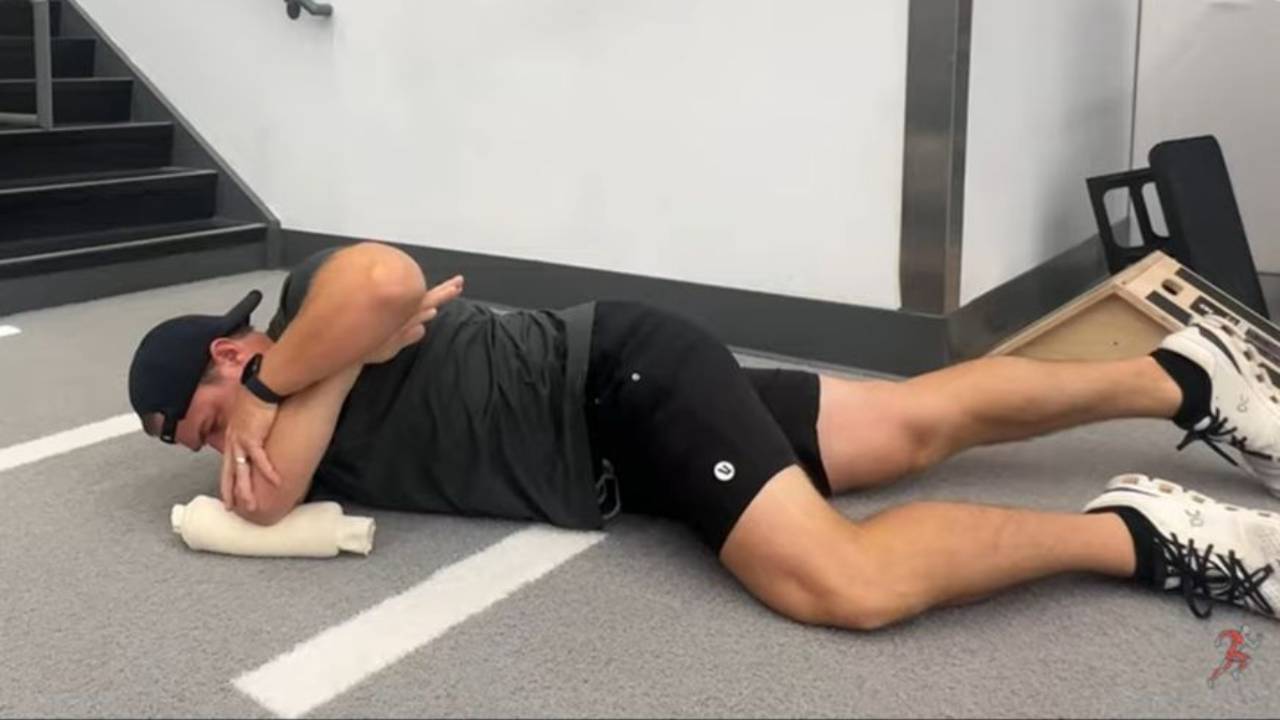
Exercise Overview
The side-lying cross-body shoulder stretch is a posterior shoulder mobility exercise that combines a mild internal-rotation bias with controlled horizontal adduction to target the posterior shoulder and posterior capsule.
Clinical Purpose
Used to improve posterior shoulder mobility, horizontal adduction, and shoulder internal-rotation tolerance when posterior shoulder restriction contributes to limited motion.
Primary Muscles
Posterior deltoid and posterior rotator cuff musculature.
The exercise is also intended to address mobility of the posterior shoulder and posterior capsule.
How to Perform
Lie on the involved side with the shoulder positioned at approximately 90° of flexion.
Place a small towel roll beneath the distal arm/elbow to support the upper extremity and establish the desired shoulder position.
Gently position the shoulder into a mild sleeper-stretch/internal-rotation bias.
From this position, rotate the torso toward the involved arm, allowing the shoulder to move progressively into a cross-body or horizontal-adduction position.
Move only to the point of a comfortable posterior shoulder stretch and return under control.
Coaching Cues
- Keep the involved shoulder supported.
- Use the towel roll to maintain comfortable arm position.
- Start with only a mild internal-rotation bias.
- Rotate the torso toward the involved arm.
- Allow the shoulder to move across the body rather than forcing the arm.
- Look for a stretch through the posterior shoulder.
- Keep the movement slow and controlled.
Common Errors
- Forcing excessive shoulder internal rotation.
- Aggressively pushing the arm across the body.
- Allowing the shoulder to become uncomfortable or pinched anteriorly.
- Losing the side-lying position.
- Using excessive pressure through the elbow.
- Rotating too quickly through the trunk.
- Treating the exercise as a maximal-range stretch.
Common Clinical Uses
Posterior shoulder mobility restriction, limited shoulder horizontal adduction, reduced shoulder internal rotation, overhead-athlete rehabilitation, throwing-athlete mobility, and shoulder rehabilitation.
Programming
2–4 sets of 20–45 second holds.
The amount of internal rotation and trunk rotation can be adjusted based on available motion, symptoms, and rehabilitation goals.
Regression
Decrease the amount of trunk rotation, reduce the internal-rotation component, or perform a standard cross-body shoulder stretch without lying on the involved side.
Progression
Increase the controlled cross-body position as tolerated, increase hold duration, or progress to more demanding posterior shoulder mobility techniques when clinically appropriate.
Equipment Needed
Small towel roll
Rehab Phase
Early
PRO+ Clinical Pearl
This should feel like a posterior shoulder stretch, not an anterior shoulder pinch. The towel roll helps position the arm while the trunk rotation creates the cross-body component. Use only as much sleeper-stretch/internal-rotation bias as needed; the goal is to improve posterior shoulder mobility without aggressively forcing the humeral head or capsule.
