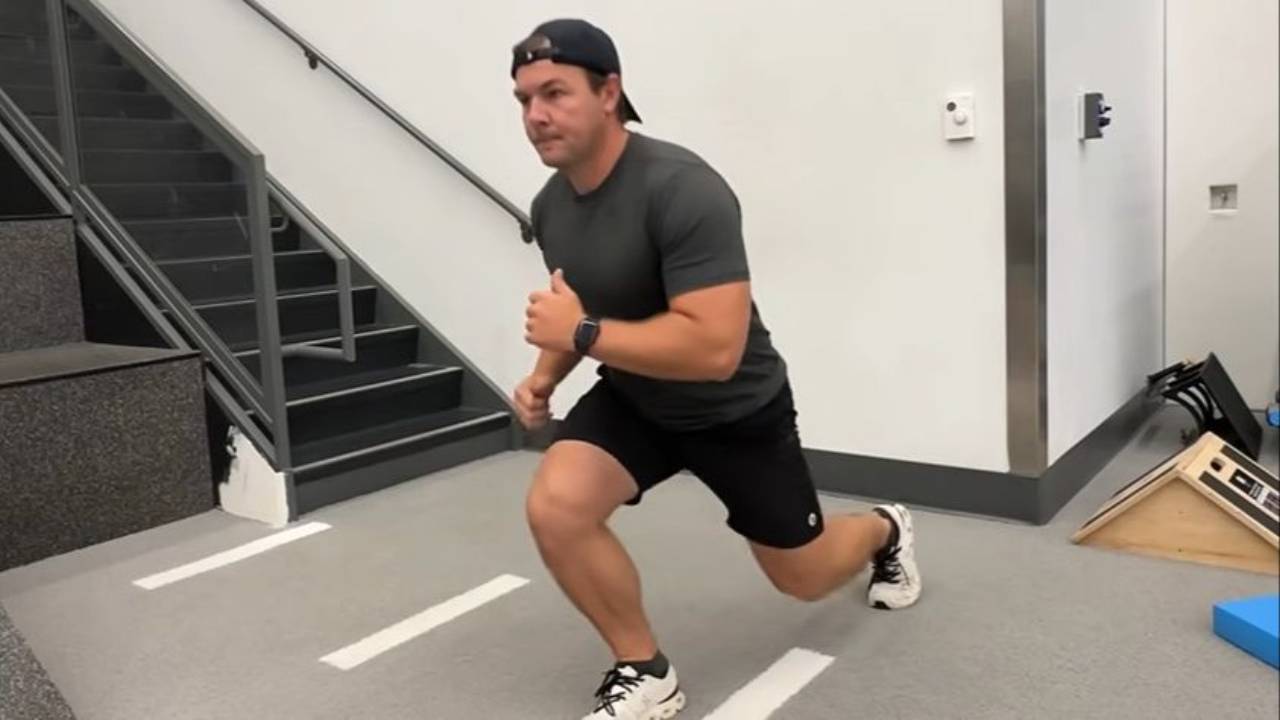
Reverse Lunge to Knee Drive
Exercise Overview
The reverse lunge to knee drive is a dynamic unilateral lower-extremity exercise that transitions from a reverse lunge into a controlled single-leg stance.
Clinical Purpose
Used to develop unilateral hip and knee strength while challenging single-leg balance, dynamic stability, and lower-extremity control during the transition from a loaded position to single-leg stance.
Primary Muscles
Gluteus maximus, quadriceps
Secondary contribution from the hamstrings, calf musculature, and lateral hip stabilizers.
How to Perform
Begin standing upright. Step one leg backward into a reverse lunge while allowing the front hip and knee to flex. Drive through the front leg to return toward standing while bringing the trailing leg forward into a knee-drive position. Finish under control in single-leg stance before beginning the next repetition.
Coaching Cues
- Keep most of the load through the front leg.
- Step backward rather than reaching excessively far.
- Maintain full-foot contact on the stance side.
- Drive through the stance leg to stand.
- Finish tall over the stance leg.
- Control the knee-drive position rather than rushing through it.
Common Errors
- Pushing excessively from the rear leg.
- Allowing the stance knee to collapse inward.
- Losing balance at the top.
- Excessive trunk rotation or lateral lean.
- Using momentum to create the knee drive.
- Failing to fully control the transition into single-leg stance.
Common Clinical Uses
Hip rehabilitation, knee rehabilitation, unilateral lower-extremity strengthening, balance training, running preparation, and progression toward higher-level return-to-sport tasks.
Programming
3–4 sets of 6–12 repetitions per side.
Depth, tempo, repetition range, and external resistance can be modified according to the athlete's strength, balance, and rehabilitation goals.
Regression
Perform a standard reverse lunge without the knee drive, reduce lunge depth, use external support, or pause in bilateral stance before progressing into single-leg balance.
Progression
Add external resistance, increase movement speed, add a longer single-leg hold, transition into a calf raise, or progress toward more dynamic running- and sport-specific tasks.
Equipment Needed
Bodyweight
Rehab Phase
Mid–Late
PRO+ Clinical Pearl
The knee drive should be treated as a controlled single-leg finish, not simply an added motion at the end of the lunge. Requiring the athlete to stabilize briefly over the stance leg increases the balance and control demand without needing to make the exercise ballistic.
