
Rear-Foot Elevated Split Squat
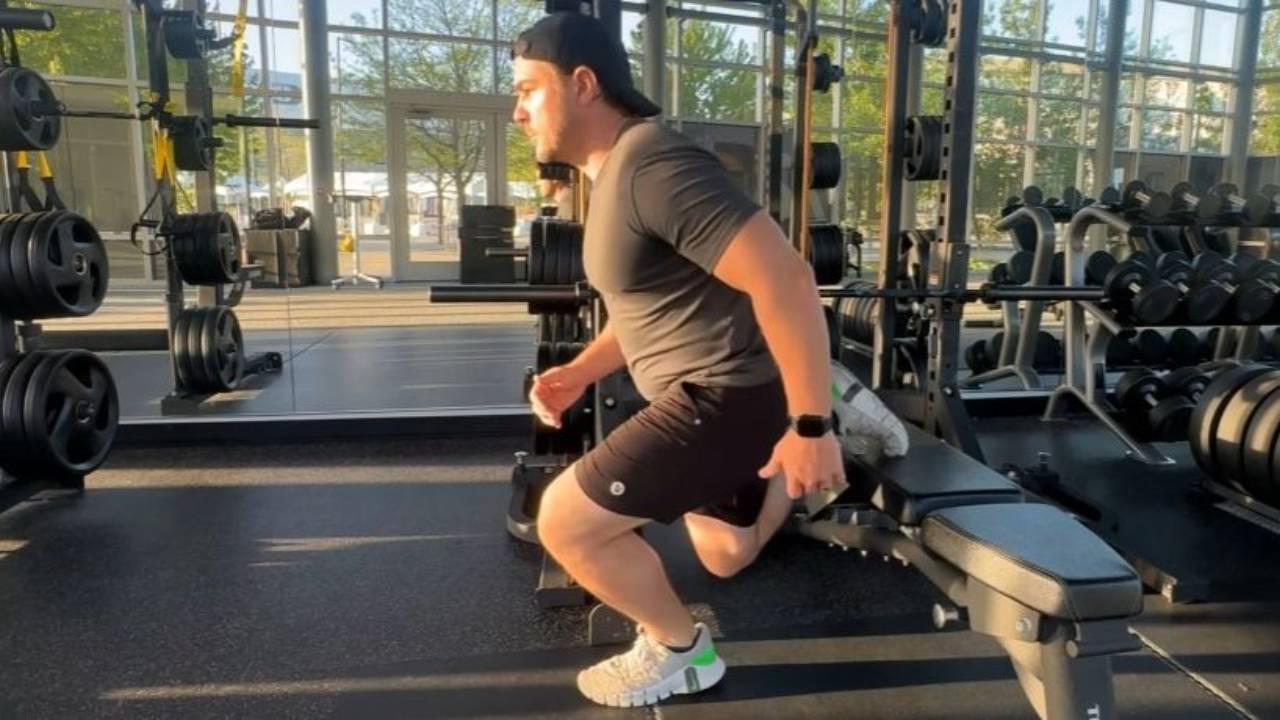
Exercise Overview
The Rear-Foot Elevated Split Squat, commonly called the Bulgarian Split Squat, is a unilateral-biased lower-extremity strengthening exercise performed with the rear foot supported on an elevated surface.
Compared with a traditional split squat, rear-foot elevation can increase the stabilization and loading demands on the front leg.
Clinical Purpose
Develop progressive quadriceps and gluteal strength, unilateral loading tolerance, balance, and control through substantial hip and knee flexion.
The exercise can be incorporated into later stages of lower-extremity strengthening when the athlete demonstrates sufficient tolerance and control with foundational split-squat variations.
Primary Muscles
-
Quadriceps femoris
-
Gluteus maximus
-
Gluteus medius (pelvic stabilization)
-
Trunk musculature (postural control)
How to Perform
-
Stand approximately one stride in front of a stable bench or step.
-
Place the top of the rear foot on the elevated surface.
-
Establish a comfortable front-foot position with adequate lateral spacing.
-
Bend the front knee and hip to lower the body under control.
-
Allow the rear knee to move toward the floor within a comfortable range.
-
Push through the front foot to return to standing.
-
Complete repetitions on one side before switching.
Coaching Cues
-
"Let the front leg do most of the work."
-
"Keep your front foot grounded."
-
"Control your pelvis and trunk."
-
"Lower through a comfortable range."
-
"Drive through the front leg to stand."
Common Errors
-
Excessively high rear-foot support causing discomfort or compensations.
-
Positioning the front foot too close to the support.
-
Excessive reliance on the rear leg.
-
Losing pelvic or frontal-plane knee control.
-
Using external loads beyond the individual's current capacity.
Common Clinical Uses
-
Progressive quadriceps and gluteal strengthening.
-
Later-stage knee and hip rehabilitation.
-
Unilateral lower-extremity strength development.
-
Preparation for higher-demand athletic tasks.
-
Addressing side-to-side differences in strength and control.
Programming
Strength: 3–4 sets of 6–10 repetitions per leg.
Motor control: 2–3 sets of 6–8 slow repetitions per leg.
Suggested tempo: 2–3-second eccentric phase with a controlled concentric return.
Increase external loading when movement quality and symptom response remain acceptable.
Regression
-
Standard Split Squat.
-
Supported Rear-Foot Elevated Split Squat.
-
Reduced range of motion.
-
Lower rear-foot support height.
Progression
-
Dumbbell Rear-Foot Elevated Split Squat.
-
Increased external resistance.
-
Slower eccentric tempo.
-
Bottom-position pause.
-
Greater range of motion when appropriate.
Equipment Needed
Stable bench or step. Optional dumbbells.
Rehab Phase
Mid-to-late-stage rehabilitation, depending on loading capacity, symptoms, and functional demands.
PRO+ Clinical Pearl
Rear-foot elevation is not automatically superior to a standard split squat. Its value is in modifying the stability, range-of-motion, and loading demands.
A more upright trunk may emphasize knee-extensor demand, while increased forward trunk inclination can alter the relative hip-extensor contribution. These effects depend on the complete movement strategy, not trunk position alone.
Select the variation that best matches the athlete's rehabilitation goals and current capacity.
