Prone Dumbbell Row
Exercise Overview
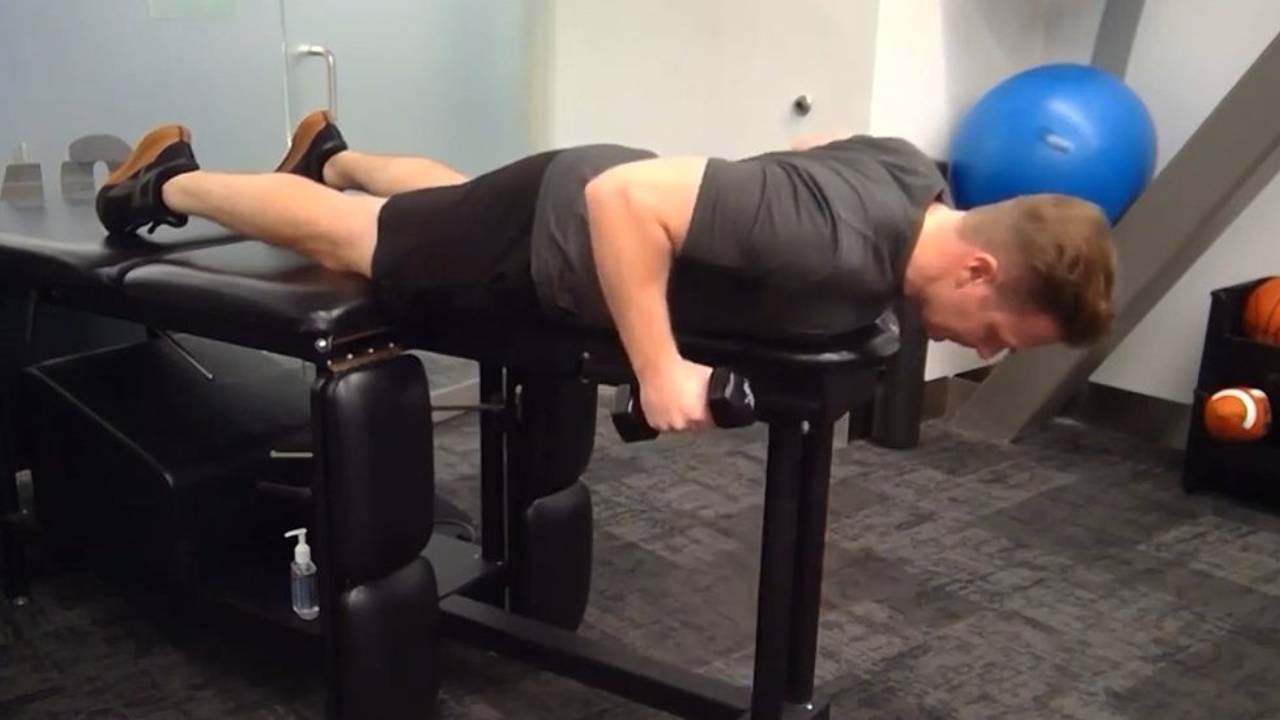
The prone dumbbell row is a supported upper-extremity strengthening exercise that combines shoulder extension, scapular retraction, and elbow flexion while minimizing trunk compensation.
Clinical Purpose
Used to strengthen the posterior shoulder and upper-back musculature while improving scapular control and horizontal pulling capacity.
Primary Muscles
Middle trapezius, rhomboids, latissimus dorsi, and posterior deltoid.
Secondary contribution from the biceps and other elbow flexors.
How to Perform
Lie prone on a bench with the chest supported and hold a dumbbell in each hand with the arms hanging toward the floor.
Begin with the shoulders relaxed in a controlled position.
Row the dumbbells toward the torso by bending the elbows and moving the upper arms toward the body.
Allow the shoulder blades to retract naturally during the pull. Pause briefly at the top, then lower the dumbbells under control to the starting position.
Coaching Cues
- Keep the chest supported on the bench.
- Pull the elbows toward the torso.
- Allow the shoulder blades to move naturally.
- Keep the neck relaxed.
- Avoid shrugging toward the ears.
- Control the lowering phase.
- Use a load that allows full scapular control.
Common Errors
- Excessive shoulder shrugging.
- Lifting the chest away from the bench.
- Using momentum to move the dumbbells.
- Excessive humeral extension beyond the available shoulder range.
- Pulling primarily with the arms without coordinated scapular motion.
- Dropping the dumbbells quickly during the eccentric phase.
Common Clinical Uses
Shoulder rehabilitation, scapular strengthening, posterior shoulder strengthening, upper-back strengthening, return-to-lifting progression, and general upper-extremity conditioning.
Programming
2–4 sets of 8–15 repetitions.
Load and repetition range can be adjusted based on strength, movement quality, rehabilitation status, and training goals.
Regression
Decrease dumbbell load, reduce rowing range, or perform a resistance-band row with lighter resistance.
Progression
Increase dumbbell load, increase time under tension, add pauses at the top position, or progress to more demanding unsupported and unilateral rowing variations.
Equipment Needed
Dumbbells and bench
Rehab Phase
Mid
PRO+ Clinical Pearl
The prone position is useful because it removes much of the athlete’s ability to generate momentum through the trunk. Focus on controlled scapular motion rather than aggressively “pinching” the shoulder blades together. The scapula should move naturally as the humerus moves through the row.
