Prone Dumbbell Horizontal Abduction
Exercise Overview
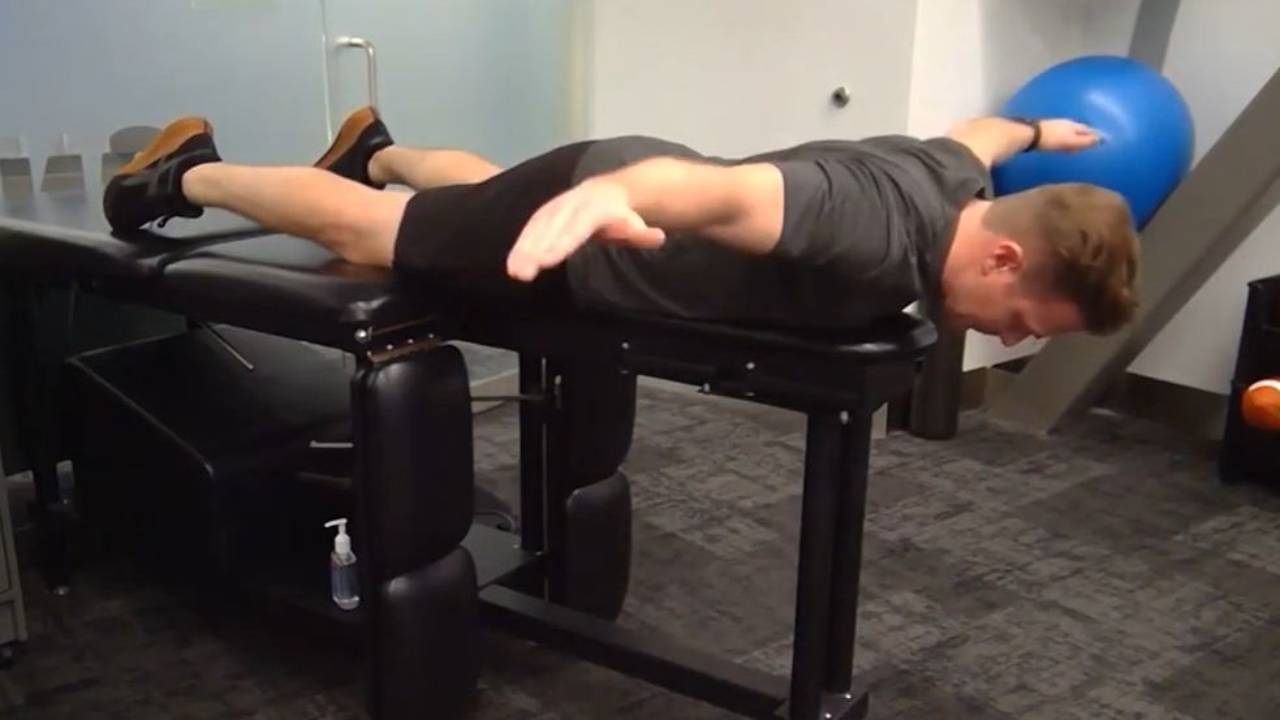
The prone dumbbell horizontal abduction is a posterior shoulder and scapular strengthening exercise performed with the trunk supported and the arms moving away from the body in the transverse plane.
Clinical Purpose
Used to strengthen the posterior shoulder and scapular musculature while improving controlled horizontal abduction and scapular retraction.
Primary Muscles
Posterior deltoid, middle trapezius, and rhomboids.
The rotator cuff and other scapular stabilizers contribute to maintaining glenohumeral and scapular control throughout the movement.
How to Perform
Lie prone on a bench with the chest supported and hold a dumbbell in each hand using a neutral grip.
Begin with the arms hanging toward the floor.
Keeping a slight bend in the elbows, raise the arms out to the sides through horizontal abduction until they approach the level of the torso.
Pause briefly, then lower the dumbbells under control to the starting position.
Coaching Cues
- Keep the chest supported.
- Maintain a neutral neck position.
- Lead the movement with the upper arms.
- Keep a slight bend in the elbows.
- Avoid shrugging toward the ears.
- Allow controlled scapular retraction.
- Use a light enough load to maintain movement quality.
Common Errors
- Excessive shoulder shrugging.
- Using momentum to lift the dumbbells.
- Extending through the trunk.
- Excessively bending the elbows.
- Raising the arms beyond a controllable range.
- Dropping the weights quickly during the eccentric phase.
Common Clinical Uses
Shoulder rehabilitation, posterior shoulder strengthening, scapular strengthening, rotator cuff rehabilitation, upper-back strengthening, and return-to-overhead or throwing progression.
Programming
2–4 sets of 8–15 repetitions.
This exercise typically responds well to lighter loads and controlled tempo because movement quality and scapular positioning are more important than maximal external resistance.
Regression
Decrease dumbbell load, reduce the horizontal-abduction range, or perform the movement without external resistance.
Progression
Increase dumbbell load gradually, add a pause at the top, increase eccentric duration, or progress to more demanding prone Y/T/W and dynamic scapular-control exercises.
Equipment Needed
Dumbbells and bench
Rehab Phase
Mid
PRO+ Clinical Pearl
Avoid turning this into a heavy reverse fly. The goal is controlled posterior shoulder and scapular loading. If the athlete begins shrugging, extending through the trunk, or generating momentum, reduce the load before increasing range or resistance.
