Low-to-High Cable Chop
Exercise Overview
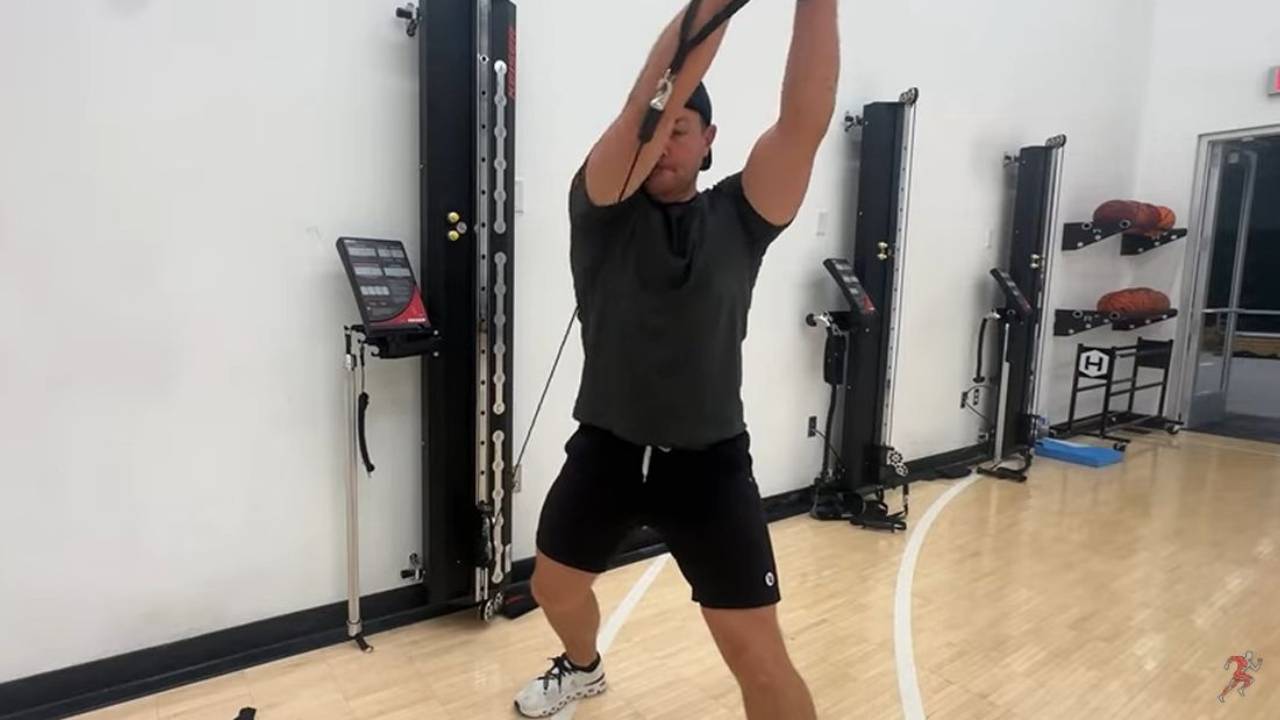
The low-to-high cable chop is a dynamic rotational trunk exercise performed by moving a cable diagonally from a low position across the body toward a higher position.
Clinical Purpose
Used to develop rotational trunk strength, coordinated movement through the hips and torso, and the ability to transfer force through a diagonal multiplanar pattern.
Primary Muscles
Obliques, abdominal musculature, gluteal musculature, and other trunk stabilizers.
Secondary contribution from the shoulders and upper extremities during the diagonal cable movement.
How to Perform
Stand beside a cable machine with the attachment positioned low. Grasp the handle with both hands and establish a stable athletic stance. Begin with the hands near the outside of the hip closest to the cable. Rotate through the hips and trunk while moving the cable diagonally upward and across the body. Finish with the hands elevated on the opposite side, then return to the starting position under control.
Coaching Cues
- Move through the hips and trunk together.
- Keep the feet firmly connected to the floor.
- Allow controlled rotation rather than pulling only with the arms.
- Move the cable diagonally across the body.
- Maintain control through the pelvis and trunk.
- Control the return to the starting position.
Common Errors
- Performing the movement primarily with the arms.
- Excessive lumbar extension at the top.
- Losing control of the pelvis.
- Moving too quickly to maintain coordinated rotation.
- Allowing the cable to pull the athlete back to the starting position.
- Using excessive resistance that limits movement quality.
Common Clinical Uses
Trunk strengthening, rotational training, athletic preparation, kinetic-chain training, rehabilitation progression, and preparation for sports requiring diagonal or rotational force production.
Programming
3–4 sets of 6–12 repetitions per side.
Cable resistance, range of motion, tempo, and movement speed can be adjusted based on the athlete’s strength, control, and training objective.
Regression
Decrease cable resistance, decrease the range of rotation, use a more stable stance, or perform a simpler trunk-rotation exercise.
Progression
Increase resistance, increase movement speed, use a narrower or split stance, progress toward half-kneeling or sport-specific variations, or integrate more dynamic lower-extremity movement.
Equipment Needed
Cable machine
Rehab Phase
Mid
PRO+ Clinical Pearl
The goal is not simply to move the cable from low to high. Look for coordinated force transfer through the hips, pelvis, trunk, and upper extremities. If the athlete performs the movement almost entirely with the arms or compensates with lumbar extension, decrease the resistance and restore the rotational pattern.
