
Lateral Lunge
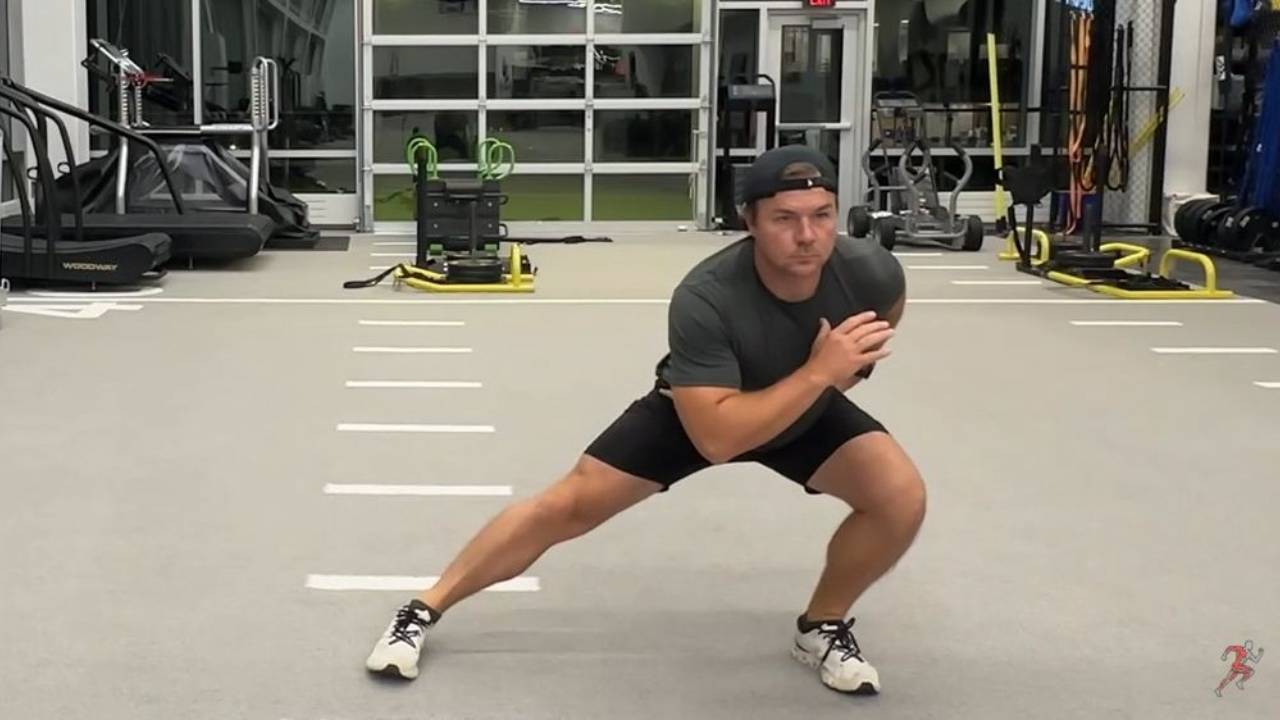
Exercise Overview
The lateral lunge is a frontal-plane lower-extremity strengthening exercise that loads one leg while the opposite leg remains extended.
Clinical Purpose
Used to develop hip, glute, adductor, and quadriceps strength while exposing the athlete to frontal-plane loading and improving lower-extremity control outside of the sagittal plane.
Primary Muscles
Gluteus maximus, gluteus medius, adductors, quadriceps
How to Perform
Begin standing with the feet together or approximately hip-width apart. Step laterally with one leg and shift the hips toward that side while allowing the working hip and knee to flex. Keep the opposite leg relatively straight. Lower under control, then drive through the working leg to return to the starting position.
Coaching Cues
- Step far enough to create room for the hips to load.
- Keep the entire working foot in contact with the floor.
- Allow the hip and knee to flex together.
- Keep the knee tracking over the foot.
- Push the floor away to return to standing.
- Maintain trunk control throughout the movement.
Common Errors
- Taking too short of a lateral step.
- Allowing the working knee to collapse inward.
- Shifting onto the toes.
- Excessive trunk rotation.
- Keeping the working knee too straight.
- Pushing primarily from the trailing leg to return to standing.
Common Clinical Uses
Hip rehabilitation, knee rehabilitation, adductor strengthening, frontal-plane strength development, lower-extremity movement retraining, and return-to-sport preparation.
Programming
3–4 sets of 6–12 repetitions per side.
Step width, depth, tempo, repetition range, and external load can be modified based on the athlete's strength and rehabilitation goals.
Regression
Reduce lateral step distance or depth, use external support for balance, or perform a lateral weight shift without returning dynamically to the starting position.
Progression
Increase range of motion, add external resistance, slow the eccentric phase, add a pause in the loaded position, or progress to more dynamic frontal-plane tasks.
Equipment Needed
Bodyweight
Rehab Phase
Mid
PRO+ Clinical Pearl
The lateral lunge is useful because it introduces substantial frontal-plane loading without requiring a high-velocity task. Rather than forcing an upright trunk, allow an appropriate hip hinge so the athlete can load the hip while maintaining foot and knee control.
