
Hamstring Walkout
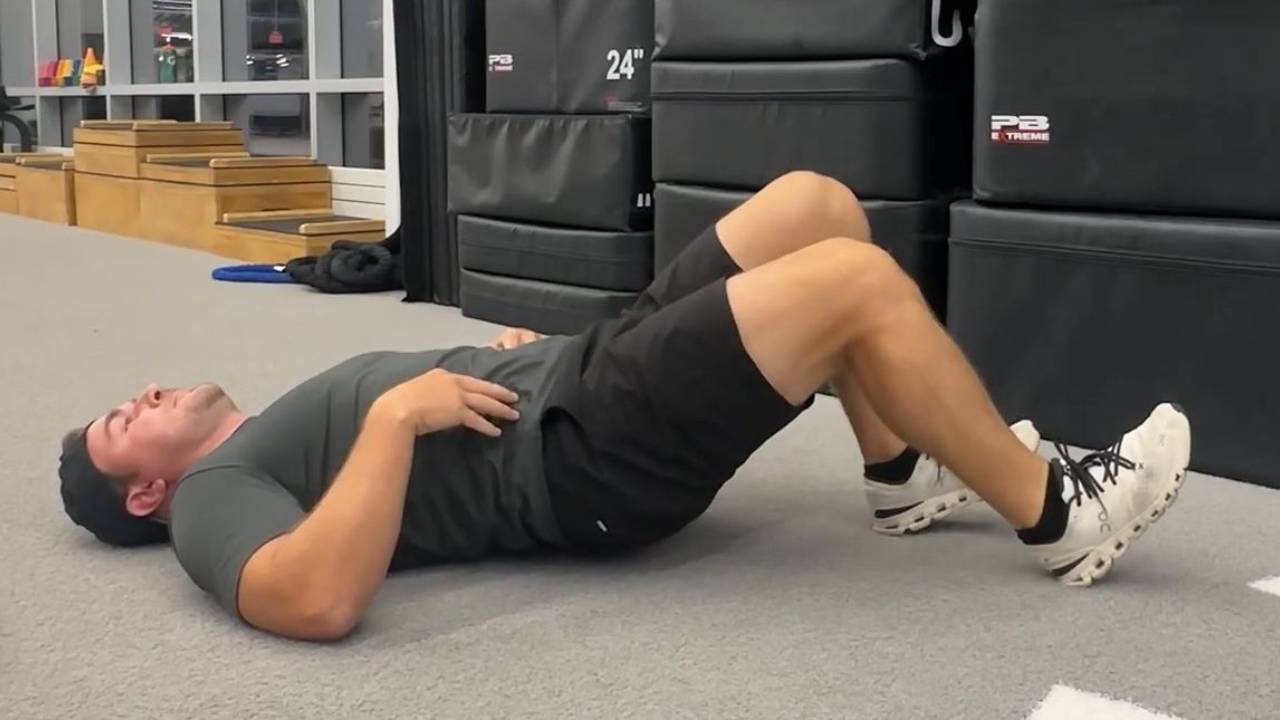
Exercise Overview
The hamstring walkout is a bodyweight posterior-chain exercise that challenges the hamstrings through progressive knee extension while maintaining an elevated hip position. It provides a useful bridge between basic isometric bridge variations and more demanding hamstring strengthening exercises.
Clinical Purpose
The hamstring walkout may be used to develop:
- Hamstring strength and loading capacity
- Posterior-chain control
- Hip-extension control
- Knee-flexor capacity
- Progressive tolerance to longer hamstring muscle lengths
- Preparation for more advanced hamstring strengthening
Primary Muscles
Primary: Hamstrings
- Biceps femoris
- Semitendinosus
- Semimembranosus
The gluteal musculature and trunk contribute to maintaining pelvic and hip position throughout the exercise.
How to Perform
- Begin lying on your back with the knees bent and feet on the floor.
- Lift the hips into a bridge position.
- Slowly walk the heels away from the body using small controlled steps.
- Maintain the elevated hip position as the knees progressively extend.
- Walk the feet back toward the starting position while maintaining control.
- Lower the hips after completing the repetition.
Coaching Cues
- Keep the hips elevated.
- Maintain a neutral pelvic position.
- Take small, controlled steps.
- Avoid allowing the hips to drop as the feet move away.
- Keep the movement smooth and controlled.
- Stop the walkout before losing position.
Common Errors
- Allowing the hips to drop
- Excessive lumbar extension
- Taking steps that are too large
- Moving too quickly
- Losing pelvic control
- Progressing farther than the athlete can control
Common Clinical Uses
The hamstring walkout may be incorporated into programs addressing:
- Hamstring strength deficits
- Hamstring strain rehabilitation
- Posterior-chain strengthening
- Running preparation
- Field and court sport rehabilitation
- Progression toward more demanding hamstring exercises
Programming
A common starting point is:
2–3 sets of 4–8 walkouts
Programming can be progressed by modifying:
- Number of steps
- Distance traveled
- Tempo
- Total repetitions
- Hip position
- Exercise variation
Dosage should be individualized based on symptoms, strength capacity, rehabilitation phase, and athlete response.
Regression
Short-Range Hamstring Walkout
Reduce the number of steps and only walk the feet as far from the body as the athlete can while maintaining hip position.
Another option is a standard bridge or bridge hold.
Progression
Potential progressions include:
- Greater walkout distance
- Slower tempo
- Increased repetition volume
- Slider hamstring variations
- Physioball hamstring curls
- Nordic hamstring curl variations
Equipment Needed
- Floor or treatment table
No additional equipment is required.
Rehab Phase
Mid Rehabilitation
The appropriate timing depends on diagnosis, symptoms, tissue status, strength capacity, and the athlete's overall rehabilitation progression.
PRO+ Clinical Pearl
The goal of the hamstring walkout is not simply to move the heels farther away. Prioritize maintenance of hip position and controlled knee extension. The athlete should only progress through the range they can actively control.
