Goblet Squat
Exercise Overview
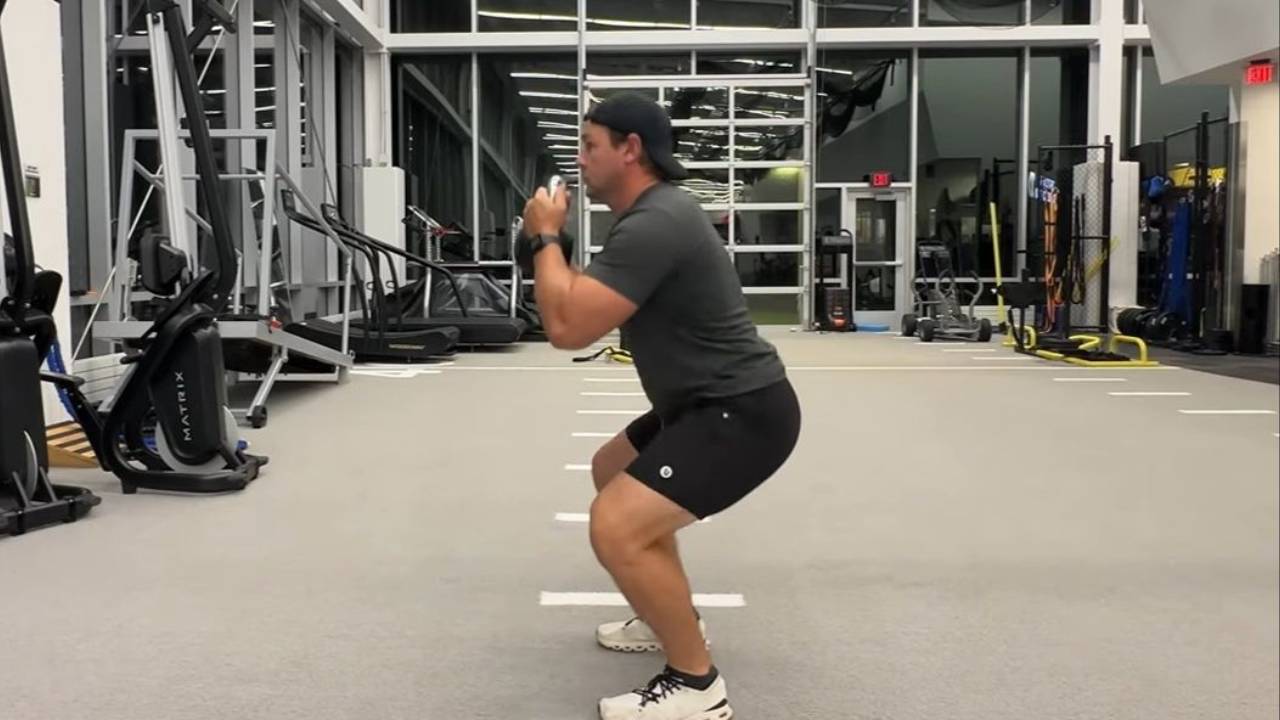
The goblet squat is a bilateral lower-extremity strengthening exercise performed while holding a kettlebell in front of the chest. The anterior load provides a useful counterbalance while challenging squat strength and control.
Clinical Purpose
Used to develop quadriceps and glute strength while reinforcing squat mechanics, trunk control, and coordinated hip, knee, and ankle motion.
Primary Muscles
Quadriceps, gluteus maximus, adductors
How to Perform
Hold a kettlebell close to the chest with both hands. Stand with the feet in a comfortable squat stance. Lower the body by allowing the hips and knees to flex while maintaining full-foot contact with the floor. Descend through the available range, then drive through the feet to return to standing.
Coaching Cues
- Keep the kettlebell close to the chest.
- Maintain full-foot contact throughout the squat.
- Allow the knees to travel naturally over the feet.
- Keep the trunk controlled as you descend.
- Sit between the hips rather than excessively shifting backward.
- Drive through the floor to return to standing.
Common Errors
- Allowing the heels to lift.
- Excessive posterior weight shift.
- Knees collapsing inward.
- Losing trunk position as depth increases.
- Holding the kettlebell too far from the body.
- Using a squat depth that exceeds available mobility or control.
Common Clinical Uses
Lower-extremity strengthening, knee rehabilitation, hip rehabilitation, squat retraining, progressive loading, and general return-to-activity preparation.
Programming
3–4 sets of 6–12 repetitions.
External load, squat depth, tempo, and repetition range can be adjusted based on the athlete's strength, rehabilitation phase, and training goal.
Regression
Reduce kettlebell load, decrease squat depth, perform a bodyweight squat, or squat to a box or target.
Progression
Increase kettlebell load, increase squat depth, add eccentric tempo or pauses, or progress toward more demanding squat and unilateral lower-extremity variations.
Equipment Needed
Kettlebell
Rehab Phase
Mid
PRO+ Clinical Pearl
The anterior goblet position can act as a counterbalance, making it a useful way to introduce external load while maintaining an upright and controlled squat pattern. Avoid forcing a standardized stance or depth—the athlete's available hip and ankle motion should help determine the most appropriate squat strategy.
