Forearm Plank
Exercise Overview
The forearm plank is a foundational trunk-strengthening exercise that challenges the abdominal musculature to maintain a stable rib cage and pelvic position while resisting lumbar extension.
Clinical Purpose
Used to improve anterior trunk strength, lumbopelvic control, and the ability to resist excessive lumbar extension under sustained isometric loading.
Primary Muscles
Abdominal musculature, including the rectus abdominis, internal and external obliques, and deeper trunk stabilizers.
The gluteal and shoulder musculature also contribute to maintaining whole-body position.
How to Perform
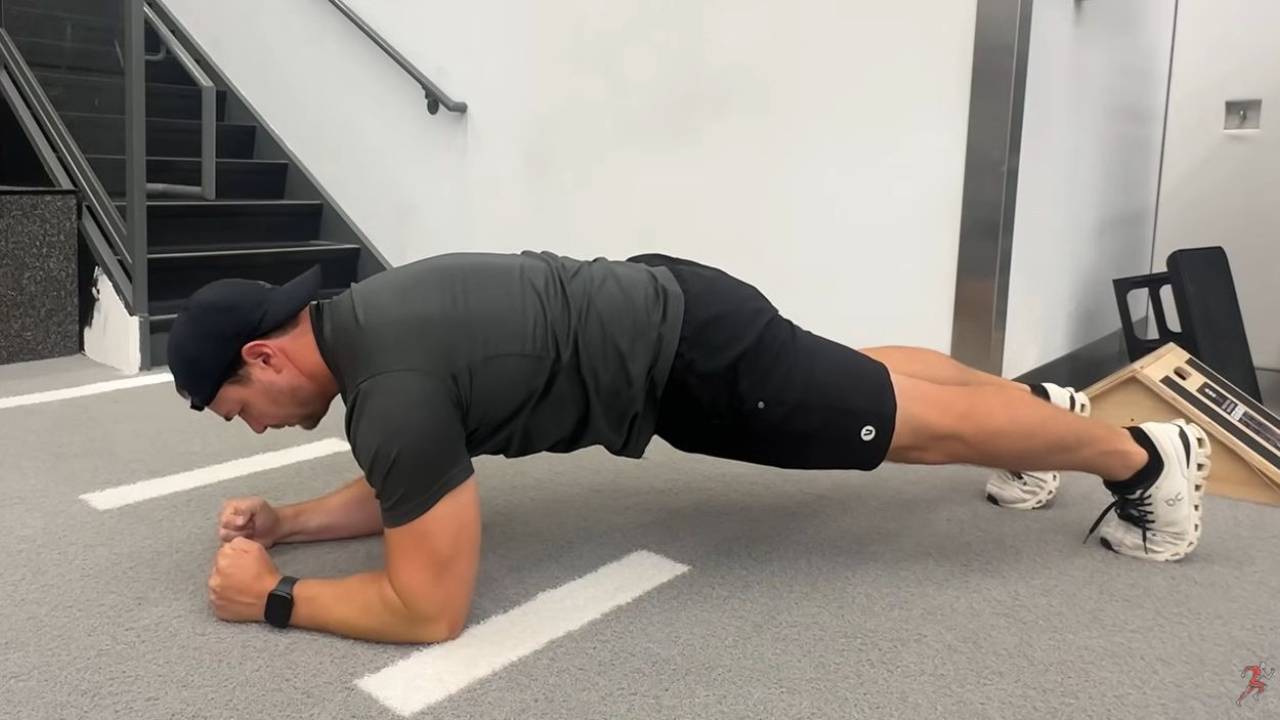
Begin lying face down with the forearms positioned on the floor and the elbows beneath the shoulders.
Lift the hips and knees from the floor so the body forms a straight line from the shoulders through the hips and ankles.
Maintain abdominal tension and a controlled rib-cage and pelvic position.
Hold the position for the prescribed duration while breathing normally.
Coaching Cues
- Keep the ribs stacked over the pelvis.
- Brace the trunk without holding your breath.
- Squeeze the glutes lightly.
- Maintain a straight line from shoulders to ankles.
- Push the forearms into the floor.
- Keep the head and neck neutral.
- Stop the set when trunk position begins to change.
Common Errors
- Allowing the low back to sag.
- Excessively elevating the hips.
- Rib flare.
- Anterior pelvic tilt.
- Holding the breath.
- Shrugging through the shoulders.
- Continuing the hold after losing trunk position.
Common Clinical Uses
Core strengthening, spine rehabilitation, lumbopelvic stabilization, general strength training, return-to-exercise progression, and preparation for more advanced anti-extension exercises.
Programming
2–4 sets of 15–45 second holds.
Duration should be based on the athlete’s ability to maintain high-quality trunk position rather than simply accumulating time.
Regression
Perform the plank from the knees, shorten the hold duration, or elevate the forearms onto a bench or table.
Progression
Increase hold duration, progress to a long-lever plank, add alternating limb movement, incorporate shoulder taps, perform a plank body saw, or add external load.
Equipment Needed
Bodyweight
Rehab Phase
Early
PRO+ Clinical Pearl
Treat the plank as an anti-extension exercise, not a test of how long someone can tolerate poor positioning. Once the athlete begins losing rib-cage or pelvic control, the set has effectively ended. High-quality shorter holds are generally more useful than prolonged holds with progressive lumbar extension.
