
Dumbbell Walking Lunge
Exercise Overview
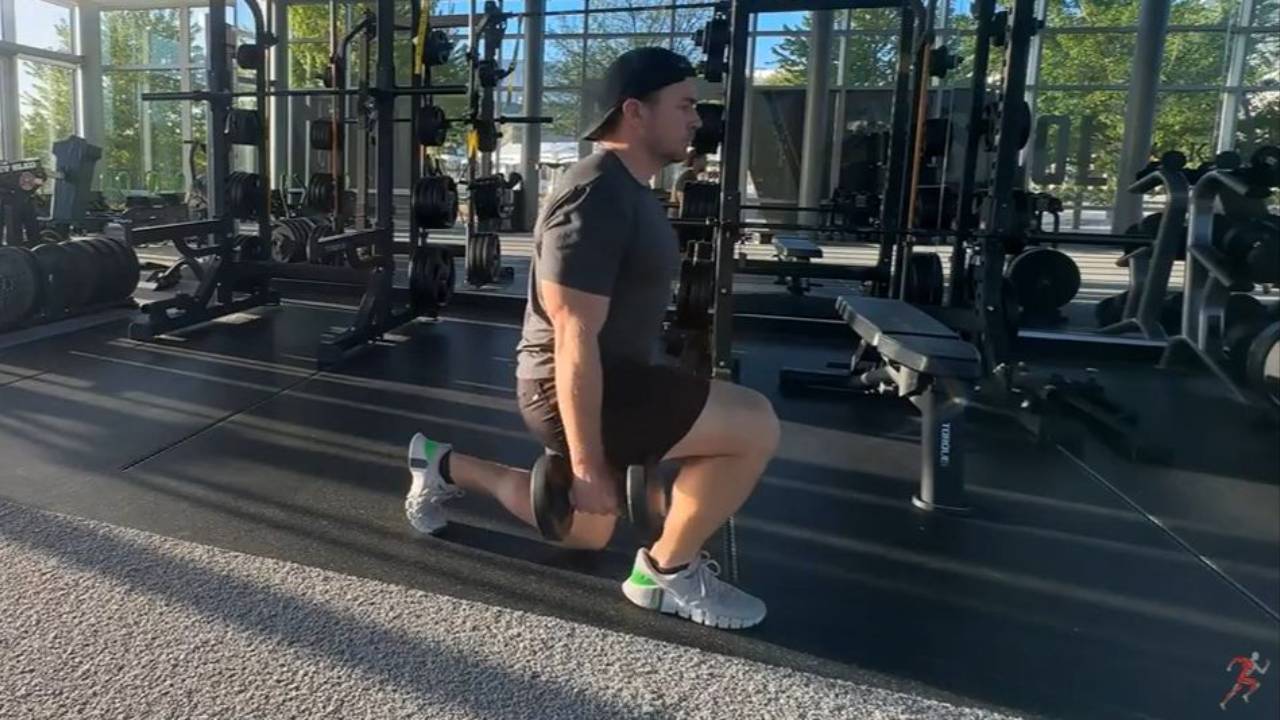
The Dumbbell Walking Lunge is a dynamic lower-extremity exercise involving consecutive forward lunges while traveling across a distance.
Unlike a stationary split squat or an in-place forward lunge, the walking lunge requires the athlete to transition from one repetition directly into the next, challenging lower-extremity strength, balance, coordination, and repeated loading tolerance.
Clinical Purpose
Improve quadriceps and gluteal strength, dynamic unilateral loading, postural control, and muscular endurance.
The continuous forward progression adds a coordination and transition component that can be valuable when preparing athletes for more dynamic tasks.
Primary Muscles
-
Quadriceps femoris
-
Gluteus maximus
-
Gluteus medius (pelvic stabilization)
-
Calf musculature (ankle stabilization)
-
Trunk musculature (postural stabilization)
How to Perform
-
Stand upright while holding a dumbbell in each hand.
-
Step forward with one leg.
-
Bend the front knee and hip to lower into a controlled lunge.
-
Maintain stability through the lead leg.
-
Push through the lead foot and transition forward into the next step.
-
Repeat the movement with the opposite leg.
-
Continue alternating legs over the prescribed distance or repetitions.
Coaching Cues
-
"Take controlled, consistent steps."
-
"Keep your front foot stable."
-
"Control the descent before transitioning."
-
"Maintain your pelvis and trunk position."
-
"Drive forward through the lead leg."
Common Errors
-
Rushing through repetitions.
-
Taking inconsistent step lengths.
-
Excessive trunk sway or loss of balance.
-
Uncontrolled knee or pelvic movement.
-
Taking steps that are too narrow.
-
Allowing fatigue to significantly alter movement quality.
Common Clinical Uses
-
Lower-extremity strength development.
-
Knee and hip rehabilitation progression.
-
Unilateral muscular endurance training.
-
Preparation for repeated dynamic loading.
-
Functional strengthening in athletic populations.
-
Transition from stationary strengthening to continuous movement.
Programming
Strength: 2–4 sets of 8–12 steps per leg.
Muscular endurance: 2–3 sets of 12–20 steps per leg using an appropriate load.
Distance-based alternative: 2–4 sets of approximately 10–20 meters.
Choose a repetition count or distance that allows controlled technique and appropriate loading throughout the set.
Regression
-
Bodyweight Walking Lunge.
-
In-Place Forward Lunge.
-
Stationary Split Squat.
-
Shorter distances or fewer repetitions.
Progression
-
Increased dumbbell resistance.
-
Longer walking-lunge sets.
-
Walking Lunges with controlled pauses.
-
Front-rack or offset loading variations.
-
Progression toward multidirectional lunging tasks.
Equipment Needed
Two dumbbells and adequate space for forward movement.
Rehab Phase
Mid-to-late-stage rehabilitation, depending on strength, dynamic control, movement tolerance, and sport-specific demands.
PRO+ Clinical Pearl
The continuous nature of walking lunges adds a repeated loading and transition demand that distinguishes them from stationary lunges.
They can be especially useful for integrating lower-extremity strength and muscular endurance, but accumulated fatigue may influence movement quality.
For athletes rebuilding strength, prioritize quality and appropriate external resistance before substantially increasing the walking distance or total repetitions.
