
Dumbbell Reverse Lunge
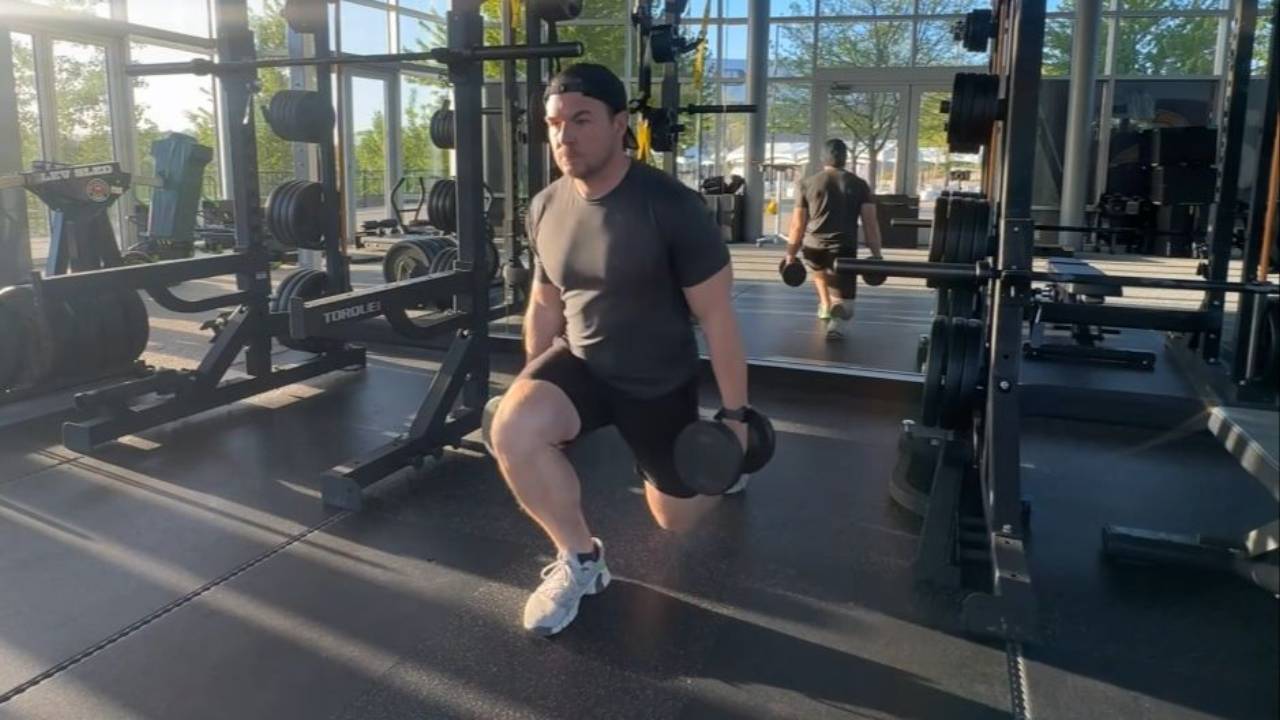
Exercise Overview
The Dumbbell Reverse Lunge is a dynamic lower-extremity strengthening exercise performed by stepping backward into a staggered stance and returning to standing.
The reverse stepping pattern allows the lead leg to remain planted while the trailing leg moves backward, providing a different loading and balance challenge than a forward lunge.
Clinical Purpose
Improve quadriceps and gluteal strength, unilateral loading tolerance, and dynamic lower-extremity control.
The exercise provides a useful progression from stationary split squats toward more demanding stepping and athletic activities.
Primary Muscles
-
Quadriceps femoris
-
Gluteus maximus
-
Gluteus medius (pelvic stabilization)
-
Trunk musculature (postural stabilization)
How to Perform
-
Stand upright with a dumbbell in each hand.
-
Position the feet approximately hip-width apart.
-
Step backward with one leg.
-
Bend both knees while lowering the body under control.
-
Maintain stable contact through the front foot.
-
Drive through the front leg to return to standing.
-
Complete repetitions on one side or alternate legs.
Coaching Cues
-
"Step back under control."
-
"Keep your front foot grounded."
-
"Lower between your feet."
-
"Keep your pelvis and trunk controlled."
-
"Drive through the front leg to stand."
Common Errors
-
Stepping backward too narrowly, causing balance difficulties.
-
Uncontrolled trunk movement.
-
Excessive reliance on the trailing leg to return to standing.
-
Loss of front-foot stability.
-
Rushing the eccentric phase.
-
Using resistance that exceeds current movement capacity.
Common Clinical Uses
-
Progressive quadriceps and gluteal strengthening.
-
Knee and hip rehabilitation.
-
Dynamic unilateral lower-extremity training.
-
Progression toward lunging and stepping activities.
-
Training lower-extremity control with external resistance.
Programming
Strength: 3 sets of 8–12 repetitions per side.
Motor control: 2–3 sets of 8 slow repetitions per side.
Suggested tempo: Approximately 2–3 seconds lowering with a controlled return to standing.
Adjust dumbbell resistance, step length, and depth according to loading tolerance and exercise goals.
Regression
-
Bodyweight Reverse Lunge.
-
Supported Reverse Lunge.
-
Stationary Split Squat.
-
Reduced depth.
Progression
-
Increased dumbbell resistance.
-
Reverse Lunge with Knee Drive.
-
Slider Reverse Lunge.
-
Reverse Lunge with an eccentric pause.
-
More demanding multiplanar lunge variations.
Equipment Needed
Two dumbbells. Bodyweight or external support can be used for regressions.
Rehab Phase
Mid-stage rehabilitation, with progression guided by movement control, strength, and symptom response.
PRO+ Clinical Pearl
Reverse lunges can be useful when an athlete is ready for dynamic unilateral-biased strengthening but does not yet require the same forward-stepping deceleration challenge as a forward lunge.
However, a reverse lunge is not inherently knee-sparing in every situation. Knee loading depends on step length, trunk position, knee excursion, depth, and external resistance.
Rather than universally prescribing reverse lunges for knee pain, select and modify the variation according to the desired loading stimulus and the individual's response.
