
Dumbbell Forward Lunge
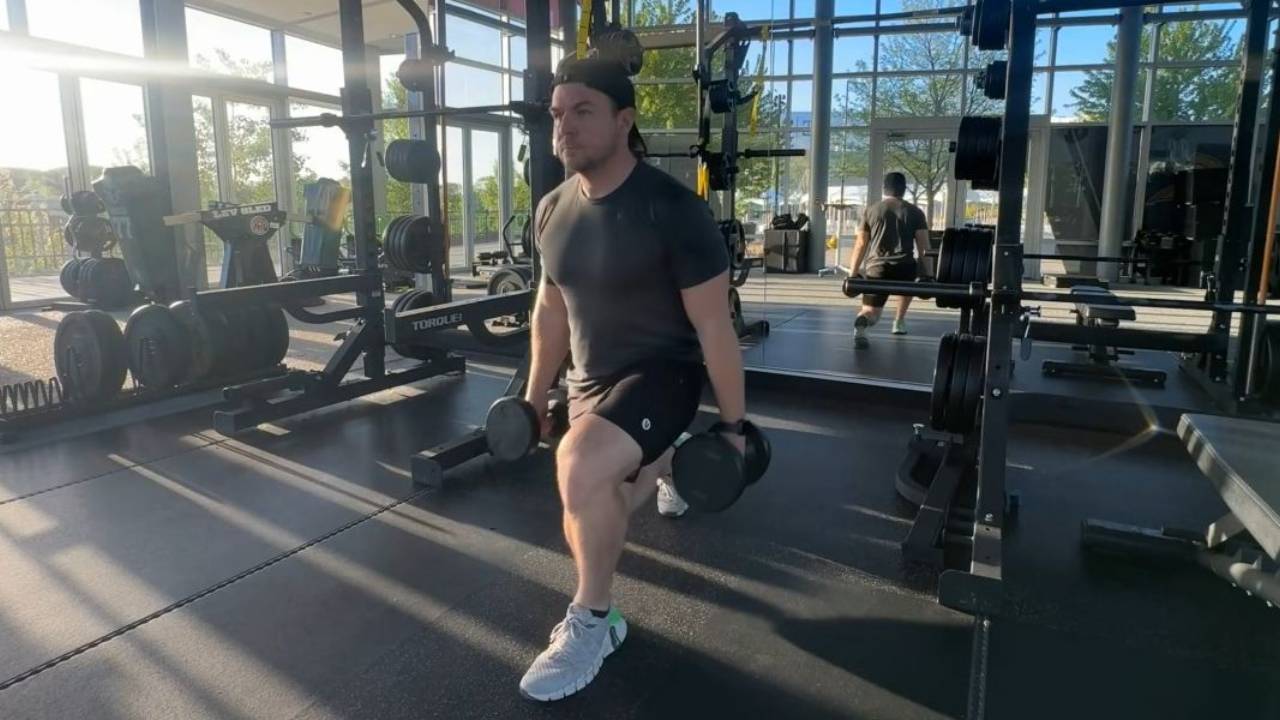
Exercise Overview
The Dumbbell Forward Lunge is a dynamic lower-extremity strengthening exercise that involves stepping forward, accepting weight through the lead leg, and returning to the starting position.
Unlike a stationary split squat, the forward lunge requires the athlete to control forward momentum during the stepping and landing phases.
Clinical Purpose
Develop quadriceps and gluteal strength while challenging dynamic lower-extremity control, eccentric loading tolerance, and single-leg stability.
The forward stepping pattern introduces deceleration demands that can be useful when progressing athletes toward more dynamic functional activities.
Primary Muscles
-
Quadriceps femoris
-
Gluteus maximus
-
Gluteus medius (pelvic stabilization)
-
Calf musculature (ankle stabilization)
How to Perform
-
Stand upright with a dumbbell in each hand.
-
Maintain a comfortable trunk position with the arms resting at your sides.
-
Step forward with one leg.
-
Bend the lead knee and hip to lower into a lunge.
-
Control the forward movement while maintaining front-foot stability.
-
Push through the front leg to return to the original standing position.
-
Repeat on the same side or alternate legs.
Coaching Cues
-
"Step forward and absorb the load."
-
"Control the landing."
-
"Keep your front foot planted."
-
"Maintain control of your knee and pelvis."
-
"Push back to your starting position."
Common Errors
-
Excessively long or short step relative to the intended movement.
-
Uncontrolled forward momentum.
-
Loss of front-foot stability.
-
Excessive frontal-plane knee motion beyond the individual's control.
-
Using momentum instead of muscular control to return to standing.
Common Clinical Uses
-
Progressive lower-extremity strengthening.
-
Quadriceps and gluteal strengthening during knee and hip rehabilitation.
-
Dynamic single-leg loading tolerance.
-
Preparation for deceleration and athletic movement tasks.
-
Progression from stationary split-squat exercises.
Programming
Strength: 2–4 sets of 6–10 repetitions per side.
Movement control: 2–3 sets of 6–8 controlled repetitions per side.
Suggested tempo: Controlled stepping and lowering followed by a strong, balanced return.
Begin with a load that permits consistent movement quality across repetitions.
Regression
-
Bodyweight Forward Lunge.
-
Stationary Split Squat.
-
Supported Split Squat.
-
Reduced step length or depth as needed.
Progression
-
Increased dumbbell resistance.
-
Slower eccentric loading.
-
Forward Lunge with a pause at the bottom.
-
Dumbbell Walking Lunge.
-
More demanding multidirectional lunging patterns.
Equipment Needed
Two dumbbells. Bodyweight can be used as a regression.
Rehab Phase
Mid-to-late-stage rehabilitation, depending on the athlete's capacity to control stepping, loading, and deceleration.
PRO+ Clinical Pearl
The forward lunge introduces a meaningful deceleration component that is less prominent in a stationary split squat.
Because the athlete steps forward and must control the resulting momentum, the exercise can create a different loading challenge than a reverse lunge.
Progressing from split squats to forward lunges should be based on the athlete's ability to tolerate and control dynamic loading rather than simply increasing external resistance.
