
Chin Tuck Head Lift
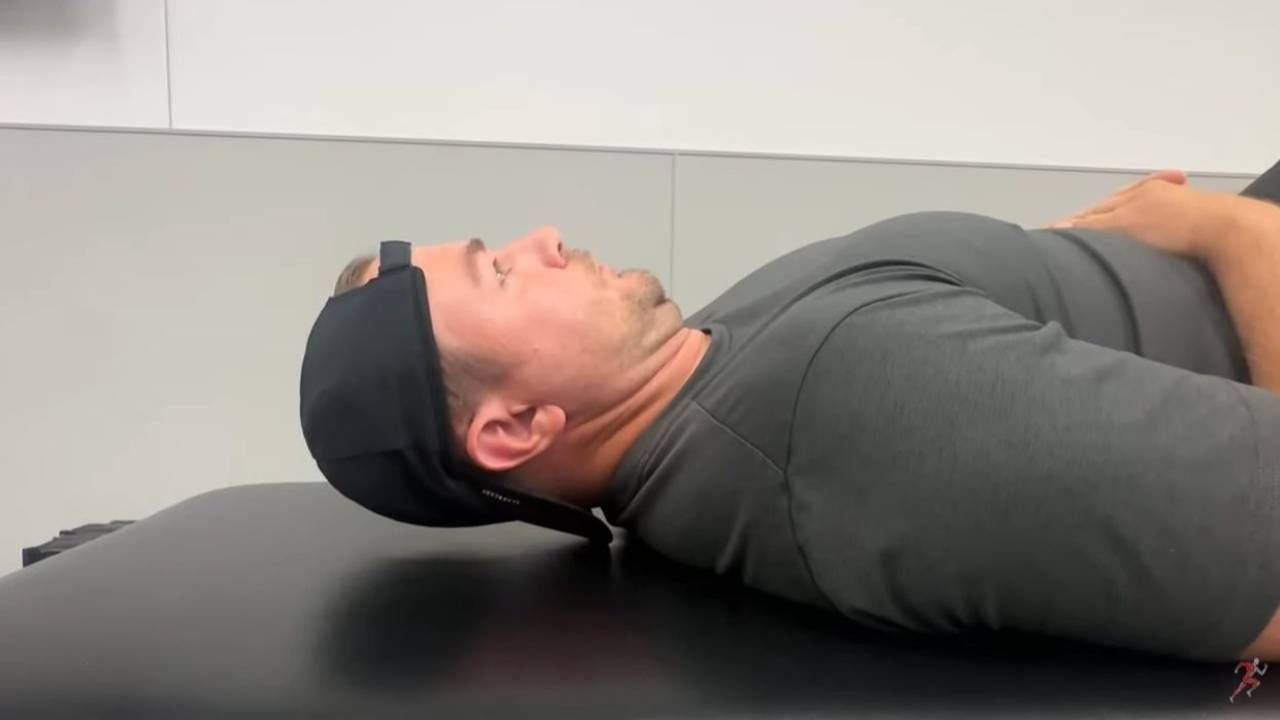
Exercise Overview
The chin tuck head lift is a cervical motor-control and endurance exercise that progresses the basic supine chin tuck by maintaining the head slightly elevated from the surface.
Clinical Purpose
Used to improve deep neck flexor endurance, cervical motor control, and the ability to maintain controlled head and neck positioning under sustained isometric demand.
Primary Muscles
Deep cervical flexors, including the longus colli and longus capitis.
The sternocleidomastoid and other cervical musculature also contribute to maintaining the elevated head position.
How to Perform
Lie on your back with the head supported.
Begin with a gentle chin tuck.
Maintaining the chin-tuck position, lift the head slightly from the surface.
Hold the position while keeping the chin tucked and the cervical spine controlled.
Lower the head back to the surface under control.
Coaching Cues
- Establish the chin tuck before lifting.
- Lift the head only slightly from the surface.
- Keep the chin tucked throughout the hold.
- Think about making the back of the neck long.
- Keep the shoulders relaxed.
- Breathe normally.
- Stop the hold if cervical position begins to change.
Common Errors
- Allowing the chin to rise.
- Excessive cervical extension.
- Lifting the head too high.
- Excessive superficial neck-muscle tension.
- Holding the breath.
- Losing the chin-tuck position as fatigue develops.
- Continuing the hold after movement quality deteriorates.
Common Clinical Uses
Cervical rehabilitation, deep neck flexor training, cervical motor-control progression, neck endurance training, and progression toward more advanced multidirectional cervical exercises.
Programming
2–4 sets of 10–30 second holds.
You can also use shorter 5–10 second holds for multiple repetitions when initially developing control and endurance.
Regression
Return to the basic supine chin tuck with the head supported, shorten the hold duration, or reduce the amount of head lift.
Progression
Increase hold duration, progress to the Chin Tuck Head Lift with Cervical Rotation, or progress to the Chin Tuck Head Lift with Cervical Side Bending.
Equipment Needed
Bodyweight
Rehab Phase
Mid
PRO+ Clinical Pearl
The goal is not to lift the head high. A small head lift while maintaining the chin tuck substantially increases the demand on the cervical flexors. Once the chin begins to rise or the neck moves into extension, the athlete has exceeded the useful duration of the hold.
