Cable Pallof Press
Exercise Overview
The cable Pallof press is an anti-rotation trunk exercise performed by pressing the arms away from the body while resisting the rotational force created by the cable.
Clinical Purpose
Used to improve trunk control, lumbopelvic stability, and the ability to resist transverse-plane rotation while the upper extremities move relative to a stable torso.
Primary Muscles
Obliques, transverse abdominis, rectus abdominis, and other trunk stabilizers.
Secondary contribution from the gluteal musculature and shoulder girdle.
How to Perform
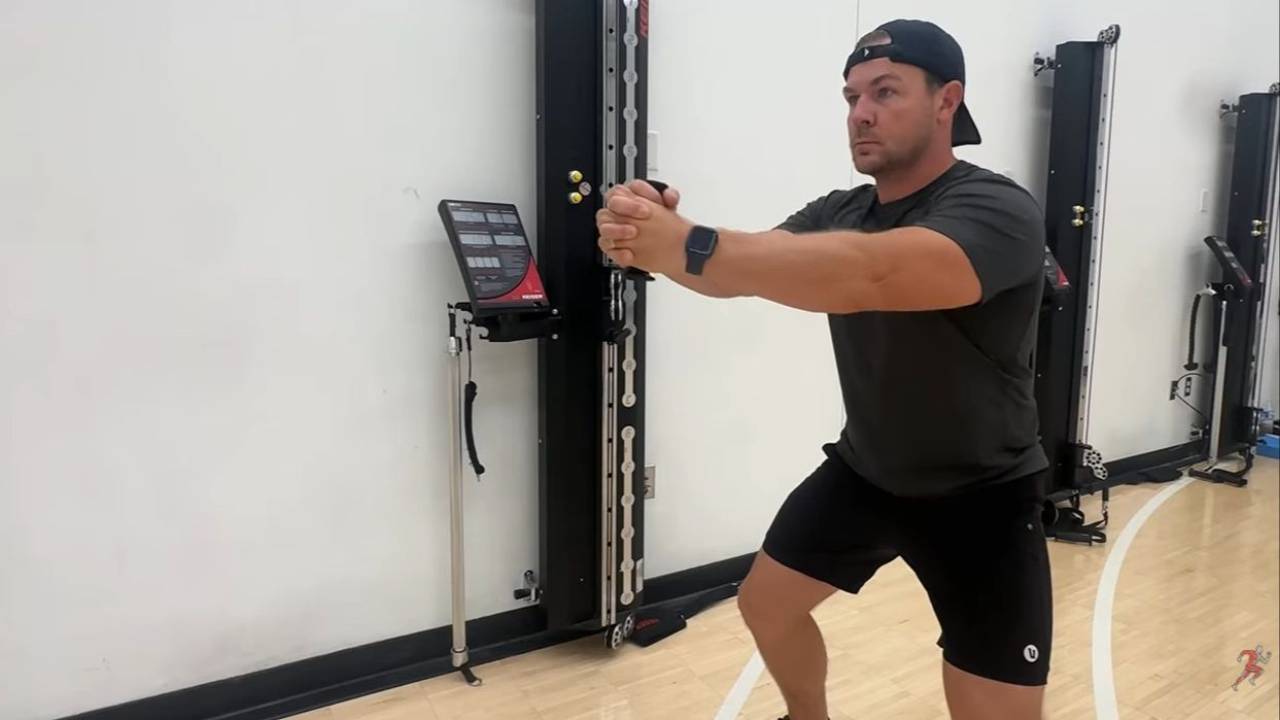
Stand perpendicular to a cable machine and hold the handle with both hands near the chest. Establish a stable stance and brace the trunk. Press the hands directly away from the chest while preventing the torso and pelvis from rotating toward the cable. Return the hands to the chest under control and repeat.
Coaching Cues
- Keep the rib cage stacked over the pelvis.
- Brace before pressing.
- Press straight away from the chest.
- Keep the shoulders and hips facing forward.
- Resist rotation toward the cable.
- Control both the press and return.
Common Errors
- Rotating toward the cable.
- Excessive lumbar extension.
- Shifting or rotating the pelvis.
- Pressing the hands off-center.
- Using excessive resistance.
- Holding the breath.
Common Clinical Uses
Trunk strengthening, anti-rotation training, lumbopelvic control, rehabilitation, athletic preparation, and progression toward more demanding multiplanar trunk exercises.
Programming
3–4 sets of 8–15 repetitions per side.
Cable resistance, stance, pressing distance, tempo, and repetition range can be modified according to the athlete’s strength and control.
Regression
Decrease cable resistance, shorten the pressing distance, widen the stance, or use a more stable starting position.
Progression
Increase cable resistance, use a narrower or split stance, perform in half kneeling, add pauses at full extension, or progress toward more dynamic anti-rotation tasks.
Equipment Needed
Cable machine
Rehab Phase
Mid
PRO+ Clinical Pearl
The arms should move while the trunk does not. The Pallof press is most effective when the athlete can maintain rib-cage and pelvic position as the lever arm increases. If the torso rotates or extends as the hands move away, reduce the load or shorten the press.
