Bird Dog
Exercise Overview
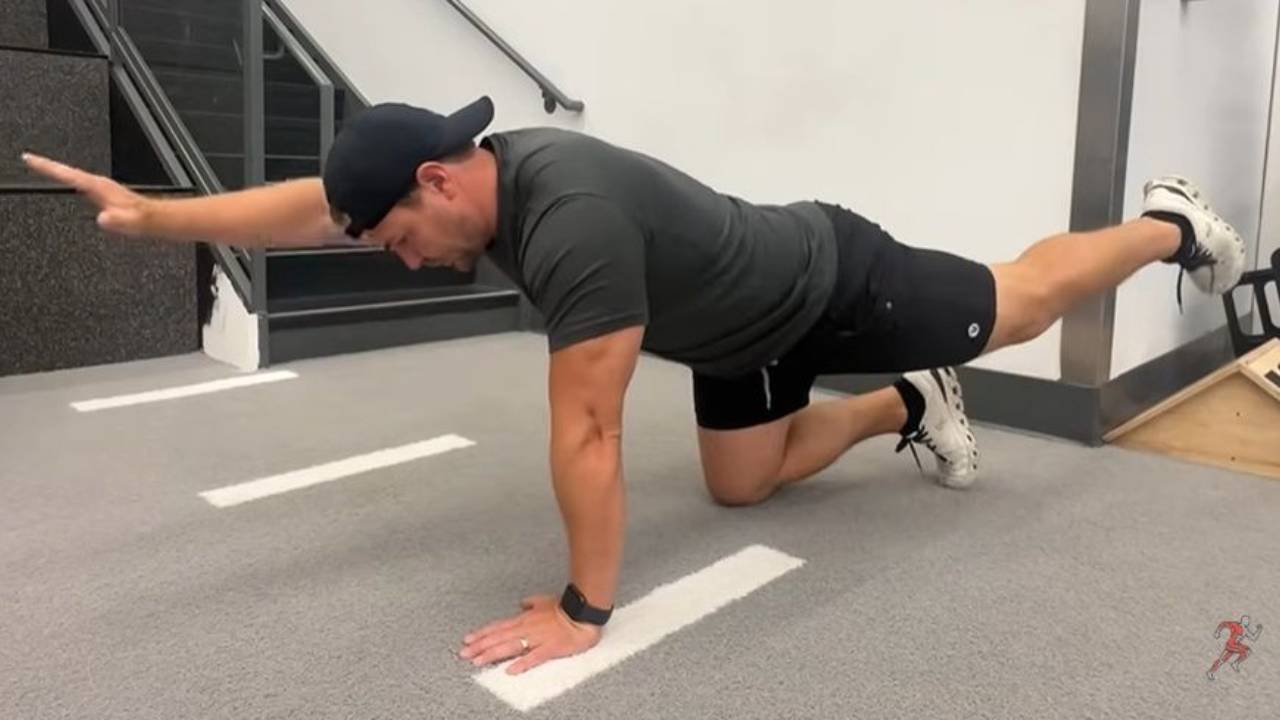
The bird dog is a quadruped trunk-control exercise performed by extending the opposite arm and leg while maintaining a stable spine and pelvis.
Clinical Purpose
Used to improve lumbopelvic motor control, trunk stability, contralateral coordination, and the ability to resist unwanted rotation and extension during extremity movement.
Primary Muscles
Abdominal musculature and trunk stabilizers.
Secondary contribution from the gluteal musculature, lumbar extensors, shoulder musculature, and scapular stabilizers.
How to Perform
Begin on your hands and knees with the hands positioned beneath the shoulders and the knees beneath the hips.
Establish a neutral trunk and pelvic position.
Slowly extend one leg behind you while simultaneously reaching the opposite arm forward.
Maintain trunk and pelvic position throughout the movement. Pause briefly, return to the starting position under control, and repeat on the opposite side.
Coaching Cues
- Keep the trunk quiet as the arm and leg move.
- Reach long rather than lifting excessively high.
- Keep the pelvis level.
- Maintain a neutral spine.
- Avoid shifting your weight excessively from side to side.
- Move the opposite arm and leg together.
- Perform each repetition slowly and deliberately.
Common Errors
- Rotating the pelvis as the leg extends.
- Excessive lumbar extension.
- Lifting the leg too high.
- Losing abdominal control.
- Shifting excessively toward the supporting side.
- Moving too quickly.
- Reaching for range instead of maintaining trunk position.
Common Clinical Uses
Spine rehabilitation, lumbopelvic motor-control training, trunk strengthening, hip-extension control, general rehabilitation, and preparation for more demanding integrated trunk exercises.
Programming
2–4 sets of 6–12 repetitions per side.
A 2–5 second pause in the extended position can be used to increase the motor-control and endurance demand.
Regression
Perform only the leg movement, perform only the arm movement, decrease the range of extremity motion, or maintain a static quadruped position while practicing trunk control.
Progression
Increase hold duration, add external resistance, perform from a narrower base of support, add band resistance, or progress to more dynamic contralateral trunk-control exercises.
Equipment Needed
Bodyweight
Rehab Phase
Early
PRO+ Clinical Pearl
The goal is not to see how high the athlete can lift the arm or leg. The useful range ends when pelvic rotation, lumbar extension, or trunk shifting begins. A smaller excursion with excellent lumbopelvic control is preferable to a larger motion with compensation.
