
Banded Terminal Knee Extension
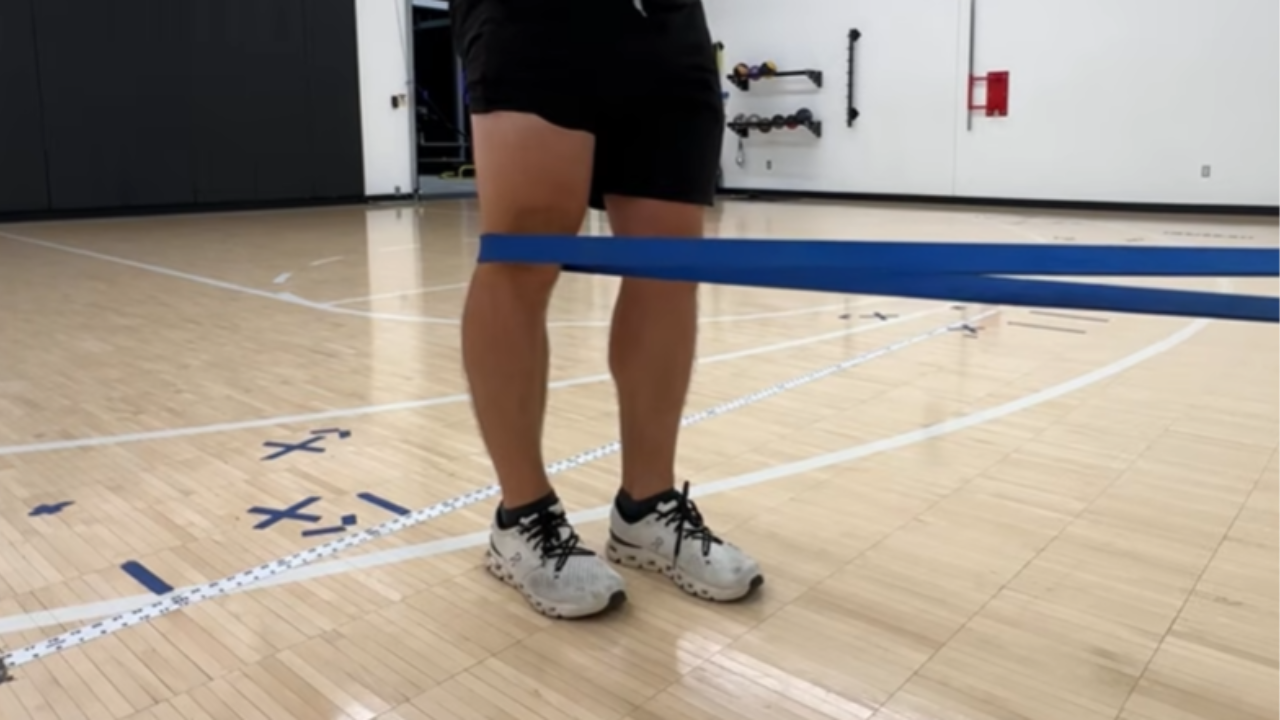
Exercise Overview
The Banded Terminal Knee Extension is a closed-chain knee exercise used to reinforce active terminal knee extension and quadriceps control in a weight-bearing position.
A resistance band placed behind the knee creates a flexion force that the athlete must overcome by actively extending the knee. It is commonly used during knee rehabilitation as a bridge between basic quadriceps activation and more demanding lower-extremity strengthening.
Clinical Purpose
The primary goal of the Banded Terminal Knee Extension is to improve active knee extension and quadriceps control near terminal range.
It can be useful when an athlete has regained passive knee extension but continues to demonstrate difficulty actively controlling the knee during standing, gait, or functional activity.
The exercise can also provide a simple way to progressively reintroduce weight-bearing quadriceps loading following knee injury or surgery.
Primary Muscles
Quadriceps
How to Perform
- Secure a resistance band to a stable anchor at approximately knee height.
- Loop the band behind the working knee.
- Step backward until the band creates tension and gently pulls the knee into flexion.
- Begin with the working knee slightly bent and the foot flat on the floor.
- Maintain an upright trunk and place weight through the working leg.
- Contract the quadriceps and straighten the knee against the resistance of the band.
- Reach full comfortable knee extension without aggressively forcing hyperextension.
- Pause briefly in the extended position.
- Slowly allow the knee to bend back to the starting position.
- Repeat with controlled movement.
Key Coaching Cues
- Push the back of your knee into the band.
- Straighten the knee using your quadriceps.
- Keep your heel planted.
- Keep your trunk tall.
- Pause briefly when the knee reaches full extension.
- Control the return into knee flexion.
- Avoid leaning your entire body backward to move the band.
Common Errors
Leaning backward
Avoid using the trunk or body weight to create knee extension. The movement should primarily come from active quadriceps contraction.
Lifting the heel
Maintain full foot contact with the floor throughout the exercise.
Moving too quickly
Use a controlled contraction into extension and a controlled return into flexion.
Excessive hyperextension
The goal is controlled terminal knee extension rather than aggressively forcing the knee beyond the athlete's comfortable range.
Using excessive resistance
Too much band resistance may encourage compensatory movement and reduce movement quality.
Common Clinical Uses
ACL rehabilitation, anterior knee rehabilitation, quadriceps inhibition, restoration of active terminal knee extension, early-to-mid stage knee rehabilitation, and progressive weight-bearing quadriceps strengthening.
General Programming
A general starting point is:
2–4 sets of 10–20 repetitions
A brief 1–3 second hold at terminal knee extension can be used to emphasize quadriceps contraction and control.
Choose a resistance level that allows full comfortable knee extension without compensation.
During early rehabilitation, prioritize repeated high-quality quadriceps contractions rather than maximizing resistance.
As strength improves, progress toward exercises that provide greater quadriceps loading through larger ranges of motion.
Regression
- Reduce band resistance.
- Reduce the amount of knee flexion at the starting position.
- Shift less body weight onto the involved limb.
- Use external support for balance.
- Perform quadriceps sets before progressing to standing TKEs.
- Use basic open-chain quadriceps activation if active knee extension remains limited.
Progression
- Increase band resistance.
- Increase weight-bearing through the involved leg.
- Add a longer isometric hold at terminal knee extension.
- Perform a mini squat followed by terminal knee extension.
- Perform the exercise in a split stance.
- Progress to step-ups.
- Progress to split squats.
- Progress to single-leg squat variations.
- Progress to heavier knee-dominant strengthening.
Equipment Needed
Resistance band and stable anchor point
Rehab Phase
Early to Mid
PRO+ Clinical Pearl
Do not treat the Banded Terminal Knee Extension as a “VMO isolation” exercise.
The quadriceps work together to produce knee extension. The value of the TKE is primarily its ability to provide an accessible way to practice active terminal knee extension and quadriceps control in a weight-bearing position.
If an athlete can easily perform high repetitions of TKEs but continues to demonstrate meaningful quadriceps weakness, the next step is typically greater progressive quadriceps loading rather than simply using a stronger band.
Clinical Purpose
The Banded Terminal Knee Extension is a closed-chain exercise used to improve active terminal knee extension and quadriceps control in a weight-bearing position.
A resistance band placed behind the knee creates a flexion force that the athlete must overcome by actively contracting the quadriceps and extending the knee.
This exercise can be useful during knee rehabilitation when an athlete has regained passive knee extension but continues to demonstrate difficulty actively controlling terminal extension during standing and functional tasks.
It can also serve as a bridge between basic quadriceps activation exercises and more demanding weight-bearing strengthening.
How to Perform
-
Secure a resistance band to a stable anchor at approximately knee height.
-
Loop the resistance band behind the working knee.
-
Step backward until the band creates enough tension to gently pull the knee into flexion.
-
Begin with the working knee slightly bent and the foot flat on the floor.
-
Maintain an upright trunk and place the majority of your weight through the working leg.
-
Contract the quadriceps and straighten the knee against the resistance of the band.
-
Reach full comfortable knee extension without aggressively forcing the knee into hyperextension.
-
Pause briefly in the fully extended position.
-
Slowly allow the knee to bend back to the starting position.
-
Repeat while maintaining control throughout the movement.
Coaching Cues
- Push the back of your knee into the band.
- Straighten the knee by contracting your quadriceps.
- Keep your heel planted.
- Keep your trunk tall.
- Finish with the knee fully straight.
- Pause briefly at the top.
- Slowly control the knee as it bends back into the starting position.
- Avoid using your entire body to pull against the band.
Common Errors
Leaning the trunk backward
The athlete may shift their entire body backward rather than actively extending the knee with the quadriceps. Maintain an upright trunk and keep the movement focused at the knee.
Lifting the heel
Keep the foot planted to maintain a stable weight-bearing position and avoid compensating through the ankle.
Moving too quickly
Rapid repetitions can reduce control through terminal knee extension. Emphasize a deliberate contraction into extension and a controlled return into flexion.
Excessive knee hyperextension
The goal is controlled terminal knee extension, not aggressively driving the knee beyond the athlete's comfortable range.
Using excessive band resistance
Too much resistance can alter mechanics and encourage compensatory movement. Choose a resistance that allows the athlete to reach full knee extension with good quadriceps control.
Programming
A general starting point is:
2–4 sets of 10–20 repetitions
Use a resistance level that allows the athlete to achieve full comfortable knee extension while maintaining good movement quality.
A brief 1–3 second pause in terminal extension can be used to emphasize quadriceps contraction and control.
During early rehabilitation, prioritize repeated high-quality quadriceps contractions rather than maximizing resistance.
As strength and function improve, the Banded Terminal Knee Extension should typically become one component of a broader quadriceps strengthening program rather than the primary strengthening exercise.
Progressions & Regressions
Progressions
- Increase band resistance.
- Increase the amount of weight placed through the working leg.
- Add a longer isometric hold in terminal knee extension.
- Perform a mini squat followed by terminal knee extension.
- Perform the exercise in a split stance.
- Progress to step-ups.
- Progress to split squats.
- Progress to single-leg squat variations.
- Progress to heavier knee-dominant strengthening exercises.
Regressions
- Reduce band resistance.
- Reduce the amount of knee flexion at the starting position.
- Use a bilateral stance with less weight through the involved limb.
- Use external support for balance.
- Perform a quadriceps set before progressing to weight-bearing terminal knee extension.
- Use basic open-chain quadriceps activation if active knee extension remains difficult.
PRO+ Clinical Pearl
Do not treat the Banded Terminal Knee Extension as a “VMO isolation” exercise.
The quadriceps function together to produce knee extension. The primary value of this exercise is its ability to provide an accessible way to practice active terminal knee extension and quadriceps control in a weight-bearing position.
If an athlete can easily perform high repetitions of Banded TKEs but continues to demonstrate meaningful quadriceps weakness, simply increasing the band resistance is unlikely to solve the problem.
Progress toward more demanding quadriceps loading as soon as the athlete is able to tolerate it.
